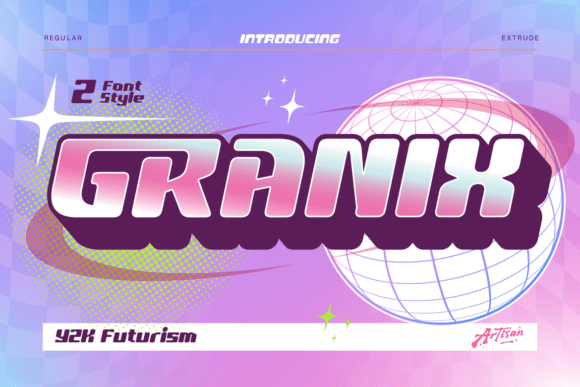
Granix: Elevating Retro-Future Design with Bold Bubble-Tech Typography
In the fast-paced world of visual communication, capturing attention within a fraction of a second is the ultimate challenge. For designers, brand managers, and content creators targeting Gen Z and millennial audiences, standard sans-serif fonts often fail to convey the necessary energy or cultural relevance. This is where Granix enters the creative toolkit. As a playful yet powerful display font, Granix bridges the gap between nostalgic Y2K aesthetics and modern street culture, offering a solution for projects that demand immediate visual impact without sacrificing legibility.
Granix is not merely a decorative typeface; it is a strategic design asset inspired by retro-future aesthetics and early 2000s digital vibes. Its unique bubble-tech style combines chunky letterforms with smooth, dynamic curves, creating a personality that feels both familiar and forward-thinking. Whether you are designing album art for a hyperpop release, branding a streetwear label, or creating scroll-stopping social media graphics, understanding how to leverage Granix can transform your visual output from generic to unforgettable.
Solving the Engagement Crisis in Modern Design
Creative professionals today face a specific set of challenges when trying to resonate with younger demographics or subcultures. The primary issue is saturation. Audiences are bombarded with clean, minimalist corporate typography that, while functional, lacks emotional resonance. When a design feels too sterile, it fails to connect with communities rooted in music, gaming, and fashion. The goal is often to evoke a sense of nostalgia mixed with futuristic optimism, but achieving this balance is difficult. Using actual vintage fonts can result in poor readability and licensing issues, while modern geometric fonts often lack the requisite "soul."
Furthermore, versatility is a constant pain point. A font that works perfectly for a concert poster might look disjointed on an Instagram story or a merchandise tag. Designers need a typeface that maintains its character across various scales and mediums. Granix addresses these friction points by offering high-impact aesthetics engineered for contemporary digital and print environments. It provides the texture and weight associated with retro graphics while adhering to modern spacing and rendering standards, ensuring your message remains clear even as it shouts.
How Granix Addresses Specific Creative Needs
The core strength of Granix lies in its ability to act as a visual anchor. Its chunky proportions naturally draw the eye, making it ideal for headlines, logos, and key messaging. However, unlike many novelty fonts that sacrifice form for function, Granix retains excellent readability. The smooth curves prevent the letterforms from feeling aggressive, allowing the font to remain approachable and fun. This duality makes it exceptionally useful for brands that want to appear edgy but not alienating.
For those navigating the resurgence of Y2K and cyber-aesthetics, Granix serves as an authentic shorthand. Instead of relying on cliché clip art or overused glitch effects, the typography itself carries the thematic weight. The bubble-tech influence suggests a tactile, almost inflatable quality that pairs beautifully with 3D renders, metallic textures, and vibrant gradients. By integrating Granix, designers can establish a cohesive retro-future mood instantly, reducing the time spent searching for complementary visual elements.
Practical Applications Across Industries
Understanding where and how to apply Granix is essential for maximizing its effectiveness. While it is a display font meant for large sizes, its utility spans multiple disciplines. Below are practical scenarios where this typeface delivers measurable aesthetic improvements.
- Streetwear Fashion Branding: In fashion, typography is often as important as the garment itself. Granix works exceptionally well for logo locks, chest prints, and woven labels. Its bold weight ensures visibility on fabric, while its playful nature aligns with current trends in skate and urban culture. Pair it with utilitarian technical fonts for secondary text to create a balanced, high-contrast hierarchy.
- Music Industry Visuals: From hip-hop to electronic and hyperpop, album covers and promotional flyers require distinct identities. Granix captures the chaotic yet melodic energy of these genres. For streaming platforms where artwork is viewed at thumbnail size, the thick strokes of Granix remain legible, ensuring artist names and titles are recognizable even on mobile screens.
- Social Media Content Creation: Attention spans on platforms like Instagram and TikTok are fleeting. Using Granix for video thumbnails, carousel headers, or story overlays creates an immediate hook. The font’s inherent vibrancy encourages engagement and shares, particularly when combined with kinetic typography or motion graphics.
- Gaming and Tech Interfaces: Indie games and tech startups targeting niche audiences benefit from Granix’s retro-digital lineage. It evokes the optimism of early internet culture and arcade aesthetics. Use it for title screens, achievement badges, or marketing assets to signal a fun, user-centric experience rather than a cold, corporate product.
- Event Marketing and Posters: For festivals, club nights, and pop-up markets, information hierarchy is critical. Granix serves as an effective Tier-1 element for event names and dates. Its distinctive shape allows it to stand out against busy photographic backgrounds or complex illustrations without getting lost in the noise.
Implementation Strategies for Different Users
While Granix is versatile, different users should approach implementation based on their specific outcomes. Graphic designers working on commercial branding should treat Granix as the "voice" of the brand, using it sparingly for maximum impact. Overusing a display font can dilute its power; reserve it for moments where you need to make a statement, and support it with neutral sans-serifs for body copy and legal text.
Content creators and social media managers, conversely, can be more liberal with their usage. In the context of ephemeral content, consistency builds recognition. Establishing Granix as your standard headline font helps create a template system that speeds up production while reinforcing brand identity. For this group, experimenting with color treatments—such as gradients, outlines, and drop shadows—is encouraged to keep the feed visually fresh.
Musicians and independent artists should view Granix as part of their world-building. The font choice contributes to the lore of the project. If the music is abrasive and experimental, consider distressing or warping the Granix letterforms. If the vibe is euphoric and dance-oriented, keep the type clean and pair it with glossy, high-saturation colors. The adaptability of the font allows it to shift tone based on the surrounding art direction.
Best Practices and Useful Considerations
To get the most out of Granix, keep a few technical and stylistic considerations in mind. First, always prioritize contrast. Because the letterforms are inherently heavy, they require ample negative space around them. Crowding Granix against other elements reduces its impact and hurts readability. Let the bubbles breathe.
Second, consider case sensitivity. Display fonts often have distinct personalities in uppercase versus lowercase. Test both variations for your specific application. Uppercase Granix tends to feel more architectural and commanding, suitable for logos and posters. Lowercase can feel softer and more fluid, which may be preferable for lifestyle branding or softer musical genres.
Finally, ensure accessibility remains a priority. While Granix is highly legible for a decorative font, it should never be used for long-form body text or critical navigational elements. Reserve it for headings and short phrases. Always check color contrast ratios when placing Granix over images or colored backgrounds to ensure compliance with web accessibility standards. By treating Granix as a specialized tool rather than a universal solution, you maintain professional standards while injecting necessary creativity into your work.
Ultimately, Granix offers a practical answer to the need for expressive, culturally relevant typography. It solves the problem of bland design by providing a ready-made aesthetic that resonates with current trends while remaining grounded in solid typographic principles. For creatives looking to inject energy, nostalgia, and professionalism into their portfolios, Granix is more than just a font; it is a catalyst for more engaging, memorable visual communication.