Camry: Weaving Intrigue Through Geometric Spiderweb Typography
In the vast ecosystem of display typography, few typefaces manage to balance structural rigidity with organic horror as effectively as Camry. This captivating display typeface does not merely suggest a spooky aesthetic; it engineers one through a precise fusion of bold geometry and intricate illustration. For designers, event organizers, and content creators navigating the niche of dark fantasy and seasonal horror, understanding the mechanical and emotional weight of Camry is essential. It represents a shift away from distressed, grunge-style horror fonts toward a cleaner, high-contrast aesthetic that feels both modern and ancient.
The Anatomy of Eerie Precision
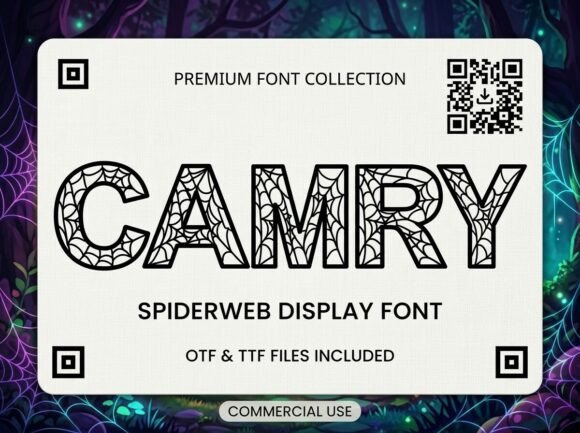
To utilize Camry effectively, one must first understand its construction. Unlike traditional blackletter or hand-drawn horror scripts that rely on irregularity to convey fear, Camry is rooted in geometric stability. The letterforms are bold and assertive, providing a solid container for the font’s defining feature: a dense tapestry of rhythmic spiderweb patterns. These are not superimposed textures but integral components of the glyph design.
The webbing within Camry serves a dual purpose. Visually, it creates a mid-tone texture that softens the harshness of the high-contrast outline, allowing the eye to traverse the letterform without fatigue. Thematically, it reinforces the concept of entrapment and complexity associated with arachnid lore. The clean outline ensures that despite this internal density, the silhouette remains legible at various scales. This distinction is critical for professionals who need a typeface that reads clearly on digital screens while retaining its tactile, illustrative quality in print.
Balancing Graphic Weight and Negative Space
A common pitfall when working with patterned display fonts is the loss of negative space, resulting in muddy reproduction or poor screen rendering. Camry addresses this through deliberate stroke modulation. The outer boundaries are thick enough to hold the internal web pattern without collapsing, yet the spacing between characters is calibrated to prevent the webs from bleeding into one another visually. When setting headlines in Camry, standard tracking adjustments should be approached with caution. Tightening the tracking too much can cause the intricate internal patterns to merge, creating an unintended blob effect. Conversely, excessive tracking can sever the visual connection between letters, breaking the "web" metaphor that unifies the word shape.
Strategic Applications in Event Branding
For independent Halloween events, haunted attractions, and immersive theater productions, branding must communicate atmosphere instantly. Camry excels in this environment because it functions as both text and image. In event signage, where readability is paramount for safety and navigation, the font’s geometric backbone ensures clarity even in low-light conditions or when printed on textured, non-reflective surfaces.
- Primary Signage: Use Camry for main entrance arches, ticket booths, and zone markers. The bold weight commands attention against dark backgrounds, while the web pattern adds depth that flat colors cannot achieve.
- Wayfinding Integration: While Camry is a display face, its clean lines allow it to pair surprisingly well with minimalist sans-serif body text. Use Camry for the destination name (e.g., "THE DUNGEON") and a clean grotesque for directional arrows and safety warnings to maintain thematic immersion without sacrificing utility.
- Merchandise Legibility: On apparel and tote bags, the high-contrast outline of Camry holds up better during screen printing than fine-line horror scripts. The internal webbing acts as a natural halftone, reducing ink coverage requirements while maintaining visual impact.
Digital Presence and Social Media Headers
Social media platforms present unique challenges for intricate typography due to aggressive compression algorithms and varying viewport sizes. Camry’s design makes it a premier choice for wicked-and-wonderful social headers because of its inherent contrast. The stark difference between the filled web pattern and the empty background creates a high-frequency visual signal that survives downscaling.
When designing Instagram stories, YouTube thumbnails, or Facebook covers, avoid placing Camry over busy photographic backgrounds. The internal detail of the font competes with photographic noise. Instead, leverage solid colors, gradients, or subtle fog effects as backdrops. This isolation allows the spiderweb rhythm to act as the primary texture of the composition. For video content, animating the reveal of Camry by having the web "spin" into place within the letterforms can create a cohesive motion graphics identity that extends the static typeface’s narrative.
Narrative Function in Publishing and Editorial
Beyond seasonal events, Camry finds a permanent home in the dark fantasy and horror publishing sectors. Book cover design requires typography that hints at the story’s tone without revealing its plot. Here, Camry operates as a semiotic shortcut. The geometric precision suggests order, magic systems, or architectural horror, while the web pattern implies danger, interconnection, or decay.
For middle-grade and young adult horror, Camry strikes an ideal balance. It is spooky enough to signal genre but lacks the gore-associated aesthetics of extreme horror fonts, making it appropriate for broader retail distribution. In editorial layouts for themed magazines or zines, Camry works best as a drop cap or pull-quote anchor. Its graphic weight draws the reader into the article, serving as a visual hook before transitioning to a highly readable serif or sans-serif for the body copy.
Pairing Strategies for Thematic Cohesion
The success of Camry in any layout depends heavily on its supporting cast. Because Camry is so visually active, it demands passive partners. Avoid pairing it with other decorative, script, or textured typefaces. The result will be visual cacophony.
- Geometric Sans-Serifs: Fonts like Futura or Avant Garde echo Camry’s underlying structure without competing for attention. This combination feels modern, clinical, and unsettlingly orderly.
- High-Contrast Serifs: Pairing Camry with a sharp transitional serif (like Baskerville or Bodoni) bridges the gap between Victorian gothic and contemporary design. The serifs pick up on the fine lines of the web pattern, creating a sophisticated dialogue between old and new.
- Monospaced Typefaces: For escape room signage or ARG (Alternate Reality Game) materials, pairing Camry with a monospace font evokes the feeling of classified documents, typewriters, or digital terminals. This juxtaposition enhances the mystery and suggests that the horror is systemic or documented.
Technical Considerations for Production
Implementing a patterned typeface like Camry requires specific technical awareness to ensure the intended eerie personality translates across media. Designers must consider the output medium’s resolution limits. In large-format printing (banners, wall murals), Camry shines as the vector details remain crisp. However, in small-scale applications like business cards or mobile app icons, the internal webbing may fill in if the point size drops below a certain threshold.
Always test Camry at the final output size before committing to production. If the web pattern becomes illegible at small sizes, consider using only the outline version (if available in the font family) or switching to a simpler typeface for secondary information. Additionally, when using Camry in web environments via @font-face, ensure the file format supports complex outlines without excessive file size bloat. WOFF2 formats typically handle intricate vector data efficiently, preserving the rhythmic spiderweb patterns without slowing page load times—a crucial factor for maintaining user engagement on event landing pages.
Color Theory and Atmospheric Enhancement
While Camry is designed with high contrast in mind, color selection profoundly influences its psychological impact. Traditional orange and black evoke nostalgia and playfulness. To leverage Camry’s more sophisticated, intriguing soul, explore alternative palettes. Deep purples and bioluminescent greens suggest toxic magic or alien horror. Monochromatic schemes using varying shades of grey or sepia can make the web pattern appear as if it were etched into aged paper or stone.
Gradient fills applied directly to the Camry glyphs can also enhance dimensionality. A vertical gradient moving from light to dark within the letterform can simulate lighting coming from above, casting the internal webs into shadow. This technique transforms the flat vector art into something that feels carved and tangible, further bridging the gap between digital design and physical reality.
Ethical and Cultural Sensitivity in Horror Design
As with any thematic design element, using Camry requires cultural mindfulness. Arachnophobia is a genuine and debilitating condition for many. While Camry is stylized and geometric rather than photorealistic, the web pattern is unmistakable. In contexts involving mental health, children’s education, or general public safety, evaluate whether the spiderweb motif could trigger distress that overshadows the intended message.
In commercial and entertainment contexts, however, Camry serves as a respectful nod to classic horror tropes without resorting to shock value. Its intricacy rewards close inspection, inviting the audience to engage with the design rather than recoil from it. This quality makes it particularly valuable for brands that wish to cultivate a loyal following based on aesthetic appreciation rather than momentary scares. By treating the horror elements as art rather than assault, designers using Camry can create experiences that are hauntingly beautiful and professionally executed.