Jumble: Infusing Festive Energy into Visual Communication Through Playful Typography
In the vast landscape of digital and print design, typography serves as the primary vehicle for emotional transmission. While clean sans-serifs convey professionalism and elegant serifs suggest tradition, there exists a specific niche where structure must yield to spontaneity. This is the domain of Jumble, a high-energy display typeface engineered to capture a festive-and-carefree soul. For designers, event planners, educators, and content creators, understanding the mechanical and psychological impact of this font is essential for projects that demand genuine joy rather than manufactured polish.
The Anatomy of Whimsy: Deconstructing Letterform Mechanics
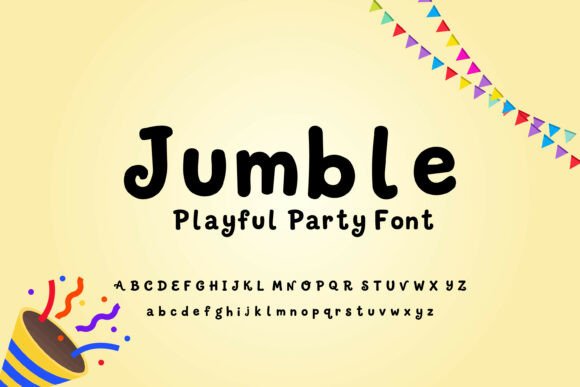
To utilize Jumble effectively, one must first understand why it elicits a positive emotional response. The typeface does not rely on randomness alone; rather, it employs specific typographic principles to simulate hand-lettered authenticity while maintaining digital legibility. The core characteristic lies in its bouncy baselines. Unlike traditional typefaces where letters sit rigidly on an invisible line, Jumble’s characters oscillate vertically. This rhythmic variation mimics the natural imperfections of human handwriting, signaling to the viewer that the content is personal, approachable, and unpretentious.
Furthermore, the letterforms are defined by bold, rounded terminals and quirky curls. Sharp angles in typography often subconsciously signal danger, urgency, or strict formality. By contrast, Jumble’s soft, friendly silhouette reduces cognitive friction. The rounded geometry creates a sense of safety and inclusivity, making it particularly effective for audiences ranging from young children to adults seeking nostalgia. The weight of the strokes is substantial enough to command attention in headers without feeling heavy or oppressive, striking a delicate balance between presence and playfulness.
Rhythmic Flow and Hand-Lettered Authenticity
The "hand-lettered feel" of Jumble is achieved through deliberate inconsistency. In professional typesetting, uniformity is usually the goal. However, in celebratory design, perfection can feel sterile. Jumble introduces controlled variance in stroke width and character spacing. This creates a visual texture that feels organic. When setting text in this typeface, designers should avoid manual kerning adjustments that force uniformity. Allowing the font’s native rhythm to breathe preserves the intended carefree aesthetic. Over-correcting the spacing destroys the very personality that makes the typeface unique.
Strategic Applications Across Industries
The versatility of Jumble extends far beyond simple party invitations. Its distinct personality traits make it a strategic asset across multiple sectors where engagement and emotional connection are key performance indicators.
- Independent Event Branding: For birthday parties, baby showers, and community festivals, generic clip art has lost its impact. Jumble provides bespoke branding potential. Its bold nature ensures readability on signage and merchandise from a distance, while its whimsical details reward closer inspection. It bridges the gap between DIY charm and professional execution.
- Children’s Education and Publishing: Educators and publishers require typography that supports literacy without intimidating early readers. The rounded, open counters of Jumble aid in letter recognition, while the playful tone maintains engagement. It is ideal for book titles, classroom labels, and educational worksheets where the goal is to associate learning with enjoyment.
- Social Media Content Creation: In the crowded feed of social platforms, stopping the scroll requires immediate visual interest. Jumble serves as an excellent choice for high-impact celebration-and-cheer headers. Its unique silhouette distinguishes brand posts from standard template graphics. Creators can use it to highlight key phrases, announce milestones, or add emphasis to video thumbnails.
- Artisanal and Small Business Packaging: Makers and small business owners often struggle to convey the "human touch" of their products through digital printing. Using Jumble on packaging labels, thank-you cards, or product tags reinforces the artisanal narrative. It suggests that the product was made with care and joy, aligning the visual identity with the values of the independent maker movement.
Pairing Strategies and Hierarchical Balance
A common pitfall when working with expressive display fonts is overuse. Jumble is a seasoning, not the main course. To maintain readability and professional standards, it must be paired with complementary typefaces that provide structural grounding.
Selecting Supporting Typefaces
Because Jumble possesses such strong character, it pairs best with neutral, geometric sans-serifs or clean monospaced fonts. A minimalist sans-serif allows Jumble to shine without competing for attention. Avoid pairing it with other script fonts or highly decorative serifs, as this creates visual noise and legibility issues. The supporting font should handle body copy, logistical details, and secondary information, reserving Jumble strictly for headlines, logos, and short emphatic statements.
Contrast is also vital in color selection. Jumble’s bold forms hold up well against vibrant backgrounds, but accessibility must remain a priority. Ensure sufficient contrast ratios between the text and background. While the font is playful, it should never sacrifice readability for aesthetics. White Jumble text on a saturated coral or teal background offers both vibrancy and compliance with accessibility standards.
Technical Considerations for Digital and Print Implementation
Implementing Jumble requires awareness of technical constraints to ensure the intended effect translates across mediums. The bouncy baseline, while visually appealing, can create alignment challenges in layout software.
- Vertical Alignment: Do not rely solely on automatic center alignment. Visually inspect the bounding box. Because some characters extend significantly above or below the mean line, automatic alignment may make the text appear off-center. Manual optical adjustment is often necessary to achieve true visual balance.
- Line Height Management: Standard leading values used for body text will cause Jumble’s ascenders and descenders to collide. Increase line height significantly when stacking multiple lines. Alternatively, treat each line of Jumble text as a separate graphic element to have total control over vertical spacing.
- Web Font Performance: When using Jumble for web headers, ensure proper subsetting if self-hosting. Display fonts often contain extensive glyph sets. Removing unused characters reduces file size and improves load times, which is crucial for maintaining user experience on mobile devices.
- Print Resolution: The rounded edges and fine curls of Jumble require high-resolution output. When printing on textured paper or at large formats, verify that the ink spread does not fill in the smaller counter spaces. Vector formats (SVG, EPS, PDF) are mandatory for scaling; rasterizing this font at low resolutions will destroy the crispness of its rounded terminals.
Psychological Impact and Audience Reception
Typography is never neutral. The choice of Jumble signals specific psychological cues to the audience. Research in environmental psychology and design semantics suggests that rounded, irregular forms are processed faster and more positively than angular, rigid ones. This is known as the "bouba/kiki" effect, where round shapes are associated with softness and friendliness.
For businesses and organizations, utilizing Jumble is a calculated risk that pays dividends in relatability. It breaks down the barrier between institution and individual. In healthcare settings focusing on pediatrics or mental wellness, it reduces anxiety. In corporate internal communications regarding celebrations or team building, it signals permission to relax. However, context remains king. This typeface is inappropriate for legal disclaimers, financial reports, or crisis communication. Its power lies in its specificity; it is a tool for moments of levity, achievement, and communal joy.
Navigating Trends Versus Timelessness
While Jumble captures a current zeitgeist of maximalist joy and anti-perfectionism, its roots lie in mid-century signage and vintage carnival aesthetics. This historical foundation gives it staying power beyond fleeting internet trends. To keep designs feeling fresh rather than dated, focus on contemporary color palettes and modern layout grids. Combining this nostalgic typeface with brutalist layouts or neon gradients creates a tension that feels current and relevant.
Ultimately, celebrating every moment with Jumble is about matching the medium to the message. It is a rejection of corporate sterility in favor of human expression. Whether designing a festival banner, a child’s birthday invitation, or a social media campaign, this typeface offers a vocabulary of joy that speaks directly to the viewer’s desire for connection and celebration. By respecting its mechanical quirks and applying it with strategic restraint, designers can harness its high-energy spirit to create work that resonates on a deeply emotional level.