Channeling the Mystical: How Draco Font Redefines Spiritual and Fantasy Branding
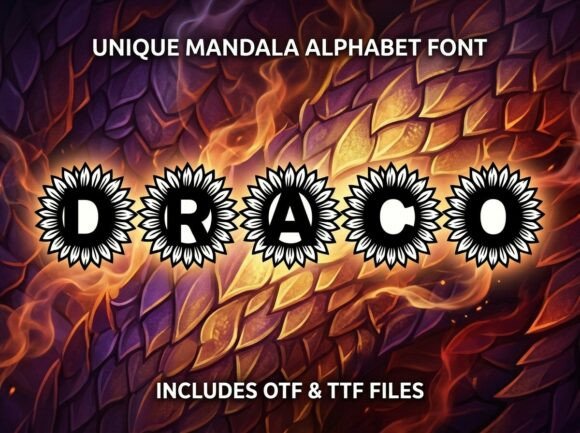
In the evolving landscape of visual identity, typography has transcended its traditional role as a mere vessel for text to become a primary driver of emotional resonance. For professionals in the creative, wellness, and entertainment sectors, the search for typefaces that convey specific, nuanced atmospheres is more critical than ever. Enter Draco, a high-impact display font that captures a spiritual-and-legendary soul unlike any contemporary alternative. This typeface does not simply spell out words; it channels the power of the mystical through bold, solid letterforms uniquely encased within rhythmic, hand-drawn mandala sunbursts.
As markets saturate with minimalist sans-serifs and clean geometric aesthetics, a counter-movement is gaining significant momentum. Audiences are craving depth, texture, and narrative. Draco sits at the intersection of this cultural shift, offering a design solution for independent fantasy branding, wellness studio identities, esoteric book covers, and high-impact social media headers. Understanding why this font matters requires looking beyond its aesthetic beauty to examine the broader industry trends, changing consumer preferences, and practical workflows that make it a relevant tool for modern creators.
The Intersection of Ancient Geometry and Modern Display Typography
To understand the market position of Draco, one must first understand what it represents technically and artistically. It is classified as a display font, meaning it is engineered for large-scale usage rather than body copy. However, where many display fonts rely on distortion or extreme stylization to grab attention, Draco utilizes sacred geometry as its foundational hook. The letterforms are heavy and graphic, providing the necessary legibility and authority required for headlines, yet they are softened and complicated by intricate, hand-drawn details reminiscent of ancient dragon scales or floral mandalas.
This duality is intentional. In typography, there is often a trade-off between weight and intricacy. Heavy fonts tend to feel industrial or aggressive, while intricate fonts can appear fragile or illegible at scale. Draco resolves this tension by using the solid letterform as a canvas for the ornamental detail. The result is a typeface that feels both grounded and ethereal. For designers and marketers, this solves a persistent problem: how to communicate "heavy" concepts like mythology, spirituality, or ancient wisdom without sacrificing modern graphic impact.
Responding to the Maximalist and Spiritual Wellness Trends
The relevance of Draco extends far beyond its visual construction; it is a direct response to current macro-trends in consumer behavior and design. We are currently witnessing a significant pivot away from the sterile minimalism that dominated the 2010s. The rise of "spiritual maximalism" in lifestyle branding reflects a consumer desire for richness, history, and tactile experiences in digital spaces.
In the wellness and yoga industry, for example, branding has matured. The generic lotus flower and thin, airy scripts of the past decade no longer suffice for studios aiming to differentiate themselves in a crowded market. Modern wellness consumers are seeking authenticity and depth. They respond to visuals that suggest lineage, ritual, and substance. Draco’s mandala-infused architecture speaks directly to this demographic. It signals that a brand is rooted in something deeper than surface-level aesthetics, aligning perfectly with businesses that offer transformative experiences, meditation retreats, or holistic health services.
Simultaneously, the fantasy and gaming sectors are experiencing a renaissance of indie development and self-publishing. Independent authors and game developers are no longer bound by the conservative typographic choices of legacy publishing houses. There is a growing demand for assets that feel bespoke and legendary. Draco fits this niche precisely because it evokes the feeling of an artifact. When used on a book cover or a game title screen, it immediately establishes genre expectations, signaling to the audience that the content within is steeped in lore and high-stakes storytelling.
Why Creators Are Prioritizing Narrative Typefaces
The attention Draco is receiving is also symptomatic of changing workflows and expectations among creative professionals. In an era of AI-generated imagery and templated design, human-centric imperfection has become a premium asset. The "hand-drawn" quality of Draco’s sunbursts provides a necessary organic counterweight to digital perfection. Professionals are paying attention to this font because it offers a shortcut to authenticity that usually requires hiring a custom lettering artist.
Furthermore, the economics of attention have shifted. On social media platforms, users scroll rapidly, making split-second decisions based on visual cues. A standard serif or sans-serif headline may be readable, but it is often forgettable. Draco acts as a visual anchor. Its heavy graphic weight ensures it stops the scroll, while its intricate details reward the viewer for pausing to look closer. This dual function—arresting attention and encouraging engagement—is exactly what social media managers and content creators need to improve performance metrics.
Practical Applications Across Industries
While Draco is undeniably distinctive, its utility lies in its versatility across specific verticals. Understanding where and how to deploy this typeface is key to maximizing its ROI for branding projects.
- Independent Fantasy Branding: For tabletop RPG publishers, fantasy novelists, and lore-heavy video games, Draco serves as an instant world-building tool. It works exceptionally well for title treatments, chapter headings, and merchandise. The dragon-scale texture implies danger and magic, reducing the need for excessive illustrative elements elsewhere in the layout.
- Wellness and Yoga Studio Identities: Moving beyond cliché spa aesthetics, Draco allows wellness brands to project strength and grounding. It is particularly effective for signage, studio wall murals, and promotional materials for intensive workshops or teacher training programs where a sense of discipline and sacredness is paramount.
- Esoteric and Occult Publishing: Tarot decks, astrology guides, and metaphysical literature require typography that respects the subject matter. Draco’s mandala geometry aligns naturally with these themes, providing a cover design that feels authoritative and respectful of the tradition rather than kitschy.
- High-Impact Social Media Headers: For influencers, podcasters, and educators in the spiritual or creative niches, channel banners and post templates utilizing Draco create immediate brand recognition. The font’s unique silhouette makes text instantly identifiable even in thumbnail sizes.
Integrating Draco into Professional Workflows
Adopting a highly stylized display font like Draco requires a strategic approach to design hierarchy. Because the font carries so much visual information, it demands breathing room. Designers should avoid pairing it with other ornate typefaces, which can lead to visual clutter and cognitive overload. Instead, the most effective workflow involves contrasting Draco with clean, neutral sans-serifs or simple serifs for body copy. This contrast amplifies the mystical qualities of the display font while ensuring the overall composition remains accessible and professional.
Additionally, color selection plays a pivotal role in unlocking Draco’s potential. While it performs beautifully in stark black and white, its intricate details shine when paired with rich, earthy tones or metallic gradients. Deep indigos, burnished golds, moss greens, and terracottas enhance the "ancient" feel of the letterforms. For digital applications, designers should test the font at various resolutions to ensure the fine mandala lines remain crisp. Fortunately, Draco’s heavy base structure maintains legibility even if some finer details soften on smaller screens, making it robust enough for responsive web design headers.
The Future of Thematic Typography
The emergence and success of fonts like Draco signal a forward-looking shift in the typography market. We are moving toward an era where typefaces are expected to do more than facilitate reading; they are expected to facilitate feeling. As virtual reality, augmented reality, and immersive digital experiences continue to grow, the demand for typography that bridges the gap between the digital and the tangible will only increase.
For entrepreneurs and marketers, staying ahead means recognizing that visual identity is no longer about fitting in with current standards but about carving out a distinct atmospheric niche. Draco represents a tool for those who understand that branding is ultimately about storytelling. By integrating typefaces that carry their own mythos, creators can build brands that resonate on a subconscious level, turning casual viewers into devoted followers.
Ultimately, choosing Draco is a strategic decision to embrace complexity and narrative in a simplified world. It acknowledges that the audience is sophisticated, visually literate, and hungry for meaning. Whether you are designing the next great fantasy epic, rebranding a sanctuary for mindfulness, or crafting a social media presence that demands reverence, Draco provides the visual vocabulary to articulate the inarticulate. It is not just a font; it is a conduit for the legendary, proving that in modern design, the mystical still holds immense power.