Conor: Rooting Visual Identity in Organic Strength
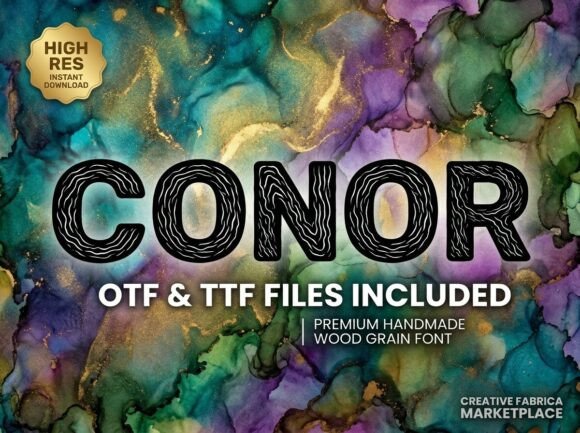
In an era dominated by sleek minimalism and digital perfection, there is a growing counter-movement toward the tactile, the imperfect, and the authentically human. Designers and brand strategists are increasingly seeking visual assets that convey substance rather than just style. Enter Conor, a rugged display typeface that captures a rustic-and-elemental soul rarely found in modern typography. This is not merely a font; it is a textural experience. Featuring bold, rounded letterforms filled with a dense, rhythmic pattern of hand-drawn wood grain rings and bark textures, Conor radiates an authentic handcrafted personality that speaks directly to audiences craving connection with the natural world.
The relevance of such a specific typographic voice cannot be overstated in today’s saturated market. As consumers become more environmentally conscious and value-driven, the aesthetic language of brands must evolve to reflect these priorities. Conor serves as a bridge between traditional craftsmanship and contemporary branding needs. Its heavy structural weight and earthy presence make it the premier choice for independent woodworking studio branding, outdoor adventure gear logos, rustic cabin retreat identities, and high-impact timber-and-trail social media headers. By integrating this typeface, creators are not just selecting letters; they are embedding a narrative of resilience, sustainability, and organic strength into their visual communication.
The Shift Toward Tactile Authenticity in Digital Spaces
For decades, the trajectory of graphic design leaned heavily toward sanitization. Vector-based cleanliness, geometric sans-serifs, and flat design principles ruled the landscape because they optimized legibility across shrinking screens. However, as digital interfaces have matured, user expectations have shifted. Audiences now associate hyper-polished aesthetics with corporate detachment or artificial intelligence generation. There is a palpable fatigue regarding the "perfect" image. In response, we are seeing a resurgence of texture, grain, and irregularity as markers of trust and quality.
Conor fits precisely into this evolving workflow. It answers the demand for digital assets that feel analog. When a user scrolls through a feed of sterile content, the dense, rhythmic pattern of hand-drawn wood grain within Conor’s letterforms acts as a visual anchor. It disrupts the smooth scrolling experience in a positive way, forcing a momentary pause to appreciate the detail. This is particularly relevant for businesses in the maker economy and outdoor sectors. For an artisan selling hand-turned bowls or a guide leading backcountry expeditions, a clean Helvetica might communicate professionalism, but it fails to communicate the feel of the work. Conor bridges that gap, ensuring the digital representation matches the physical reality of the product or service.
Evolving Brand Narratives for the Maker Economy
The rise of the independent creator and the small-batch manufacturer has fundamentally changed how brands approach identity. These entities cannot compete with mass-market giants on price or distribution; they compete on story and provenance. Typography plays a critical role in signaling this differentiation. Using a standard commercial typeface can inadvertently signal mass production, whereas a specialized display font like Conor signals intentionality.
This evolution is also tied to changing lifestyle preferences. The post-pandemic cultural shift has seen millions of adults aged 20–50 re-evaluate their relationship with nature, work, and leisure. Interest in homesteading, carpentry, hiking, and sustainable living has surged. Brands catering to these demographics need visual tools that resonate with this renewed appreciation for the elemental. Conor provides a shorthand for these values. When applied to packaging, signage, or web headers, it instantly aligns a brand with the ethos of slow living and respect for materials. It tells the viewer that the brand understands the difference between manufactured and made.
Practical Applications Across Creative Disciplines
Understanding the theoretical value of organic typography is essential, but practical application determines its success. Conor’s unique characteristics require thoughtful implementation to maximize impact without overwhelming the viewer. Because the letterforms themselves contain significant internal detail, they function best as headline elements rather than body copy. The density of the wood grain texture means that readability decreases at smaller sizes, making scale a crucial consideration in layout design.
For independent woodworking studios, Conor offers an immediate alignment between medium and message. A business card or workshop sign featuring this typeface reinforces the tactile nature of the trade. The rounded boldness suggests safety and sturdiness, while the internal texture mirrors the very material being shaped. Similarly, for outdoor adventure gear, the font conveys durability. Logos for camping equipment, trail services, or apparel benefit from the font’s heavy structural weight, which implies that the gear can withstand the elements just as well as the typography appears to.
Navigating Modern Workflows and Technical Constraints
Integrating highly textured typefaces into modern digital workflows presents both opportunities and challenges. Designers accustomed to flat vectors may need to adjust their approach when working with Conor. The intricate bark textures and grain rings are raster-friendly but can create large file sizes if not managed correctly in web environments. Professionals must balance aesthetic fidelity with performance, perhaps using Conor in SVG format for crisp scaling on retina displays or optimizing PNG exports for social media headers where load times matter.
Furthermore, accessibility remains a non-negotiable aspect of modern design. While Conor is visually striking, its textured interior reduces contrast uniformity. Designers must ensure that when using this font, they maintain sufficient contrast against the background color to meet WCAG guidelines. This often means pairing Conor with a clean, high-legibility sans-serif for supporting text. This pairing strategy not only solves accessibility concerns but also enhances the visual hierarchy, allowing Conor’s organic strength to shine as a focal point without compromising the user’s ability to navigate information.
- Social Media Headers: Utilize the full width of the banner to showcase the rhythmic flow of the wood grain pattern, creating an immersive first impression for timber-and-trail accounts.
- Packaging Design: Pair Conor with uncoated, recycled paper stocks to enhance the tactile feedback loop between the visual texture and the physical surface.
- Environmental Signage: Leverage the font’s heavy weight for wayfinding in parks or retreat centers, where legibility at a distance and thematic consistency are equally important.
- Merchandise: Apply the typeface to embroidered patches or laser-engraved goods, where the bold, rounded forms translate exceptionally well to physical manufacturing processes.
Why Texture Matters More Than Ever
We are currently witnessing a maturation of digital design where emotion is valued as highly as utility. The initial phase of the internet was about making things work; the current phase is about making things feel. This is why typefaces with inherent character are gaining traction over neutral defaults. Conor represents a specific niche within this trend: the celebration of raw materiality. It avoids the trap of looking artificially distressed or grungy; instead, it looks grown. The distinction is subtle but vital. Distress implies damage or age applied after the fact, whereas Conor’s grain patterns imply growth, structure, and biological origin.
For marketers and entrepreneurs, this distinction translates to brand perception. Consumers are adept at spotting inauthenticity. A generic "rustic" filter applied to a corporate logo feels cynical. A purpose-built typeface that structurally embodies the qualities of wood feels honest. In a marketplace where trust is the most valuable currency, honesty is a strategic asset. By rooting designs in organic strength, businesses signal that they are grounded in reality, not just trends.
Future-Proofing Through Timeless Materiality
Trends cycle rapidly, but materials endure. Wood, stone, water, and earth have been central to human design for millennia. By anchoring a visual identity in these timeless elements through typography like Conor, designers insulate their work from the volatility of fleeting fads. While neon gradients or brutalist layouts may dominate for a season, the appeal of organic warmth is perennial. This makes Conor a sound investment for brands looking to build long-term equity rather than chase short-term engagement.
Moreover, as augmented reality and spatial computing begin to reshape how we interact with digital content, textured typography will likely gain new dimensions. Fonts that already possess depth and material simulation will integrate more naturally into 3D spaces than flat vectors. Conor’s detailed surface topology prepares it for this next frontier, suggesting that its utility extends beyond current 2D applications. For forward-thinking creators, adopting such typefaces now is a way of preparing for a future where digital and physical boundaries continue to blur.
Ultimately, the choice of typography is a declaration of intent. Selecting Conor is a decision to prioritize substance, to honor the handmade, and to communicate with a voice that carries the weight of the forest. Whether for a solo artisan launching an Etsy shop or a national park updating its trail guides, this typeface offers a powerful tool for storytelling. It reminds us that even in our most advanced technological moments, we remain biological beings drawn to the patterns of the natural world. By embracing this organic strength, designers and businesses do more than decorate; they connect, grounding their digital aspirations in the enduring reality of the earth.