Myria: Integrating Botanical Whimsy into Professional Visual Identity
In the expansive landscape of digital typography, finding a typeface that balances professional elegance with genuine emotional resonance is a persistent challenge for designers and brand strategists. While minimalist sans-serifs have dominated corporate communication for decades, there is a growing demand for visual assets that convey warmth, narrative depth, and organic beauty. Enter Myria, a display font that transcends traditional letterform design by embedding illustrative elements directly into the typographic structure. This unique approach to type design offers a sophisticated solution for projects requiring a light-and-breezy soul without sacrificing legibility or structural integrity.
The Anatomy of Organic Letterforms
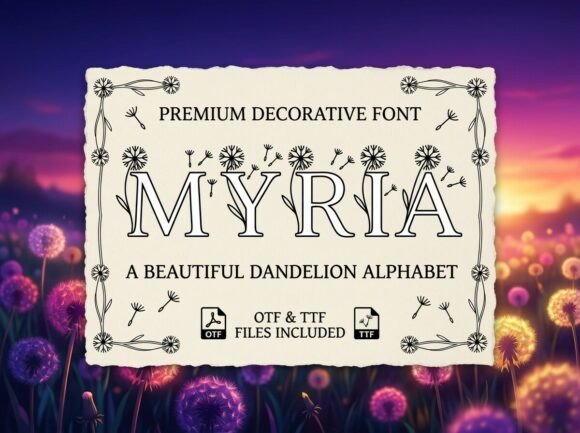
Understanding the utility of Myria requires an examination of its specific anatomical construction. Unlike standard fonts where decoration is applied as a separate layer or texture overlay, this typeface integrates rhythmic, hand-drawn dandelion puffs and drifting seeds into the serif structures themselves. The result is an elegant, hollow serif form that feels inherently connected to nature rather than artificially adorned.
The "hollow" aspect of the letterforms serves a critical functional purpose in graphic design. By reducing the visual weight of the character strokes through negative space, the font maintains a delicate decorative presence even at larger sizes. This prevents the composition from becoming visually heavy or cluttered, a common pitfall when using ornate display fonts. The integration of botanical motifs acts as a natural leading line, guiding the viewer’s eye across the composition with the same gentle unpredictability as seeds floating on a breeze. This intrinsic motion creates a dynamic reading experience that static geometric fonts cannot replicate.
Balancing Playfulness with Typographic Discipline
A primary concern when selecting whimsical typography for professional use is the risk of appearing juvenile or unrefined. Myria navigates this tension through disciplined stroke contrast and consistent baseline alignment. Despite the playful personality of the dandelion elements, the underlying skeleton of the typeface adheres to classical serif proportions. This ensures that while the font captures a dreamy aesthetic, it retains the authority and readability associated with traditional serif typography. For art directors and educators, this duality means the font can be deployed in contexts that require both imagination and credibility, avoiding the caricature-like quality often found in novelty fonts.
Strategic Applications in Brand Identity
The versatility of Myria extends beyond mere aesthetics; it functions as a strategic tool for defining brand voice. Independent creative agencies, in particular, benefit from this duality. These organizations must demonstrate technical competence while simultaneously signaling their capacity for innovative, out-of-the-box thinking. Using this typeface in agency branding communicates a respect for tradition (via the serif structure) alongside a commitment to organic creativity (via the botanical integration). It signals to potential clients that the agency values detail and narrative, distinguishing them from competitors relying on generic modernist templates.
Artisanal Packaging and Sensory Marketing
In the realm of product design, specifically artisanal fragrance packaging and boutique cosmetics, typography acts as a proxy for scent and texture. Consumers cannot smell a perfume through a screen or a sealed box; they must rely on visual cues to anticipate the sensory experience. Myria’s delicate decorative weight aligns perfectly with olfactory notes of floral, airy, or ethereal compositions. The drifting seed imagery evokes concepts of natural dispersal, purity, and botanical extraction. When applied to packaging labels or unboxing experiences, the font reinforces the premium, handcrafted nature of the product. It bridges the gap between the physical artifact and the intangible essence of the fragrance, creating a cohesive multisensory brand touchpoint.
Narrative Design in Children’s Literature
For authors, illustrators, and publishers in the children's book sector, title treatment is the first point of engagement for young readers and purchasing adults. Standard bold typefaces can sometimes feel imposing or overly commercial in this context. Myria offers a distinct advantage for whimsical children’s book titles by mirroring the thematic content of stories involving nature, dreams, or gentle adventures. The hand-drawn quality of the dandelion puffs resonates with the aesthetic of classic storybook illustration, creating an immediate sense of nostalgia and safety. Furthermore, the font’s unique characteristics allow the title itself to function as an illustrative element, potentially reducing the need for additional spot art and allowing for cleaner cover compositions that stand out in thumbnail views on retail platforms.
Social Media Headers and Digital Engagement
Digital environments present specific challenges for ornate typography due to varying screen resolutions and limited attention spans. However, high-impact dreamy-and-delightful social media headers are one of Myria’s strongest use cases. On platforms like Instagram, Pinterest, or LinkedIn, where users scroll rapidly, the distinctive silhouette of these letterforms creates an instant pattern interrupt. The hollow serifs remain legible against complex photographic backgrounds or textured gradients because the negative space allows the background image to breathe through the text. This interactivity between type and image encourages longer dwell times, as the viewer pauses to decipher the intricate details of the drifting seeds. For content creators and influencers building a personal brand around wellness, poetry, or lifestyle curation, this font provides a ready-made visual signature that feels bespoke rather than templated.
Technical Considerations for Implementation
To maximize the effectiveness of Myria, designers must adhere to specific implementation best practices. Because the font relies on fine details and integrated illustrations, scaling is paramount. It is strictly a display typeface, meaning it should never be used for body copy or small UI elements. At sizes below 24 points (or equivalent pixel dimensions), the delicate dandelion details may degrade, and the hollow strokes may become difficult to read. Optimal usage ranges from large headlines to medium-sized subheads where the intricacies remain crisp.
- Contrast Management: Ensure sufficient contrast between the hollow strokes and the background. While the negative space is a feature, low-contrast combinations can cause the letterforms to vibrate or disappear entirely on digital screens.
- Pairing Strategies: Pair Myria with clean, neutral sans-serifs or simple monospaced fonts. Avoid pairing it with other script or decorative fonts, as the competing visual noise will diminish the impact of the dandelion motifs.
- Kerning and Spacing: Due to the irregular shapes of the botanical elements, automatic kerning may not always suffice. Manual optical adjustment is often necessary to ensure the drifting seeds do not collide awkwardly with adjacent characters or create unintended visual gaps.
- Color Application: Consider using color to highlight the botanical elements separately from the main strokes if the file format supports multi-color glyphs or layered SVG usage. This can further enhance the dimensional quality of the composition.
The Psychology of Airy Typography
Beyond technical execution, the choice of Myria taps into broader psychological trends in visual communication. In an era characterized by digital saturation and information overload, audiences are increasingly drawn to visuals that offer cognitive relief. The "light-and-breezy" soul of this typeface is not merely a stylistic descriptor; it is a functional response to viewer fatigue. The organic curves and naturalistic imagery trigger biophilic responses, subtly reducing stress and increasing positive affect. For businesses and educators, leveraging this psychological association can make communications feel more empathetic and human-centric. When a user encounters a header set in Myria, the subconscious association is one of gentleness and openness, lowering defensive barriers and inviting engagement. This makes it particularly valuable for sensitive topics, mental health resources, or brands seeking to rebuild trust through transparency and softness.
Future-Proofing Visual Assets
Trends in typography cycle rapidly, but fonts rooted in natural forms tend to possess greater longevity than those tied to specific technological eras. While ultra-geometric or glitch-art fonts may date a design to a specific year, the botanical integration in Myria connects to a timeless visual language. Investing in this typeface is an investment in sustainability of style. For small business owners and independent creators with limited budgets for frequent rebranding, choosing a typeface that ages gracefully is a pragmatic financial decision. The hand-drawn quality ensures that it will not look obsolete as design software evolves, maintaining its charm and relevance across shifting digital landscapes.
Ultimately, the decision to Make a wish with Myria is a decision to prioritize emotion alongside information. It acknowledges that in a crowded marketplace, the way a message feels is just as important as what it says. Whether applied to a luxury perfume bottle, a storybook cover, or a creative agency’s manifesto, this typeface transforms standard text into a vessel of atmosphere. It proves that professional design need not be sterile, and that whimsy, when executed with precision and intent, is a powerful driver of connection and recall. By understanding its anatomical nuances, strategic applications, and technical requirements, creatives can harness this unique tool to build visual identities that are as memorable as they are beautiful.