Integrating Chaos Block into Professional Creative Workflows
In the landscape of modern graphic design and digital content creation, the search for typography that balances personality with functionality is a constant challenge. Designers and marketers often oscillate between sterile, safe sans-serifs and overly decorative scripts that sacrifice legibility for flair. Chaos Block occupies a specific operational niche in this spectrum. It is a bold, playful display font characterized by irregular, expressive letterforms that introduce raw energy without abandoning structural integrity. For professionals aged 20 to 50 managing brands, educational materials, or creative campaigns, understanding how to deploy this typeface is less about aesthetic preference and more about strategic visual communication.
Chaos Block is not intended for body copy or long-form reading. Instead, it functions as a high-impact tool for hierarchy, attention capture, and brand differentiation. Its handcrafted appearance suggests authenticity and human touch, qualities that are increasingly valuable in an era of AI-generated content and polished corporate minimalism. By integrating this font into your asset library, you are adding a resource specifically designed to disrupt visual monotony while maintaining enough consistency to remain professional. The following sections outline practical methods for implementing Chaos Block across various stages of the creative process, from initial concepting to final production.
Strategic Application in Pre-Production and Planning
The utility of Chaos Block begins before a single pixel is placed on a canvas. During the planning and mood-boarding phases of a project, typography choices dictate the emotional trajectory of the work. Because Chaos Block comes in two distinct styles, it offers immediate flexibility during the exploration phase. Designers can test both variations against color palettes and imagery to determine which weight best supports the project’s narrative. This duality prevents the common workflow bottleneck where a selected font looks good in isolation but fails when paired with supporting visuals.
When creating style guides or brand boards for clients who require a "human" or "energetic" tone, Chaos Block serves as an excellent anchor for the display tier. It signals to stakeholders that the brand voice is approachable yet confident. During this pre-production stage, it is vital to establish usage rules. Define exactly where Chaos Block applies—typically headlines, pull quotes, packaging callouts, or social media overlays—and explicitly where it does not. Establishing these boundaries early ensures that the font’s chaotic nature enhances the design system rather than destabilizing it.
Leveraging Alternate Characters for Customization
A significant advantage of Chaos Block in a professional workflow is the inclusion of alternate characters. Standard fonts often lead to repetitive visual rhythms, especially in all-caps settings or short, punchy headlines. The alternate glyphs included in this typeface allow designers to break these patterns manually, mimicking the natural variation of hand-lettering. This feature reduces the need for post-production manipulation. Instead of warping text or drawing custom letters to avoid repetition, you can cycle through alternates directly within your typesetting software.
This capability streamlines the iteration process. When presenting multiple concepts to a client or testing ad variations for A/B testing, using alternates allows each version to feel unique without requiring a complete redesign. For educators and content creators producing slide decks or worksheets, these alternates prevent visual fatigue for the audience. The ability to adjust the texture of the typography on the fly keeps the production pipeline moving efficiently while elevating the perceived quality of the output.
Enhancing Efficiency with Integrated Doodle Stickers
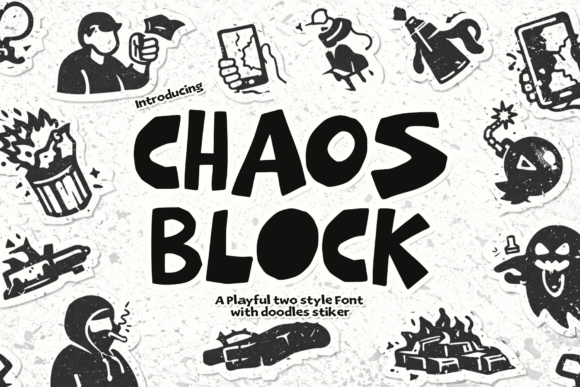
One of the most practical aspects of Chaos Block for freelancers and small business owners is the inclusion of matching doodle stickers. In many workflows, sourcing complementary graphics is a separate, time-consuming task that involves searching stock libraries, negotiating licenses, or drawing custom assets to match a specific font’s vibe. Chaos Block eliminates this friction by providing a cohesive set of playful elements designed to interact perfectly with the letterforms.
These stickers serve multiple functional purposes in execution:
- Visual Anchoring: Use doodles to ground floating headlines or connect disparate layout elements, guiding the viewer’s eye through the composition.
- Space Management: Fill awkward negative space in social media templates or poster designs without resorting to generic geometric shapes.
- Tone Reinforcement: Soften aggressive messaging or add humor to dry topics, making complex information more digestible for adult learners or consumers.
- Rapid Prototyping: Populate wireframes and mockups with relevant visuals instantly, allowing for faster feedback cycles before committing to custom illustration.
By treating these stickers as integrated UI components rather than mere decoration, creators can maintain visual consistency across large campaigns. This is particularly useful for social media managers who need to produce high volumes of content while adhering to strict brand guidelines. The assets are ready-to-use, ensuring that the energetic style of Chaos Block translates seamlessly from static print designs to dynamic digital formats.
Technical Integration and Compatibility Considerations
Implementing a display font like Chaos Block requires attention to technical details to ensure smooth operation across different platforms and software. While the font is versatile, its irregular forms demand specific handling to maintain quality. Professionals should verify OpenType feature support in their primary design tools. Accessing alternate characters and ligatures typically requires enabling specific OpenType panels in Adobe Illustrator, Photoshop, InDesign, or Affinity Designer. Failing to enable these features limits the font to its default state, negating one of its primary value propositions.
For web and digital product designers, performance and rendering are critical factors. Display fonts with complex outlines can sometimes render poorly at small sizes or on low-resolution screens. Chaos Block should be reserved for larger viewport implementations where its details remain crisp. When using it in web environments, consider subsetting the font file to include only necessary characters and alternates to reduce load times. Always test the font across multiple browsers and devices during the QA phase to ensure the handcrafted aesthetic does not degrade into pixelation or alignment issues.
Pairing Strategies for Balanced Composition
Chaos Block carries significant visual weight. To integrate it successfully, it must be paired with typefaces that provide contrast and stability. The goal is to let Chaos Block perform as the protagonist while supporting fonts handle the exposition. Neutral sans-serifs or clean, structured serifs are ideal partners. Avoid pairing it with other distressed, handwritten, or highly decorative fonts, as this creates visual noise and reduces readability.
In a practical layout workflow, establish a clear size ratio. Chaos Block headlines should be significantly larger than body text to justify their complexity. If the headline is too small, the irregularities become distracting artifacts rather than stylistic choices. Conversely, ensure adequate leading and tracking. Tight spacing in an already irregular font can cause characters to collide uncomfortably. Generous whitespace around Chaos Block elements allows the letterforms to breathe and maximizes their impact. This spatial consideration is essential for maintaining a professional appearance even when using a deliberately chaotic typeface.
Long-Term Asset Management and Consistency
For agencies and in-house teams, Chaos Block should be managed as part of a broader design system. Documenting its usage prevents brand drift over time. Create a internal reference sheet that showcases approved pairings, acceptable color treatments, and examples of alternate character usage. This documentation aids onboarding for new team members and ensures that external contractors apply the font correctly. Consistency does not mean uniformity; it means predictable quality. By codifying how Chaos Block is used, organizations can leverage its expressive power without risking visual chaos in the negative sense.
Furthermore, consider the lifecycle of projects where this font is applied. Trends in display typography shift, but the underlying need for personality remains. Chaos Block’s handcrafted nature gives it a timeless quality compared to trendy, algorithmic display fonts. However, it is still a stylistic choice. Regularly audit your design outputs to ensure the font continues to align with evolving brand values and audience expectations. If the brand matures toward a more corporate tone, Chaos Block may transition from a primary headline font to an accent element used sparingly for special campaigns or limited-time offers.
Optimizing Workflow Outcomes
Ultimately, the decision to use Chaos Block should be driven by project objectives. It is a solution for specific problems: boring layouts, impersonal branding, or the need for rapid, cohesive asset creation. By understanding its dual styles, utilizing its alternate characters, and leveraging the included sticker pack, professionals can extract maximum value from this single purchase. The font reduces dependency on external assets and accelerates the path from concept to completion.
Successful integration relies on viewing typography as a functional component of the workflow rather than just an aesthetic layer. When Chaos Block is treated with the same rigor as grid systems or color profiles, it transforms from a novelty into a reliable instrument for engagement. Whether you are a freelancer pitching a bold rebrand, an educator designing engaging course materials, or a marketer launching a summer campaign, this typeface provides the necessary tools to inject energy and personality into your work efficiently. The result is design that feels alive, intentional, and distinctly human, achieved through a streamlined and professional process.