Retro 3D Comic: Strategic Typography for High-Impact Visual Communication
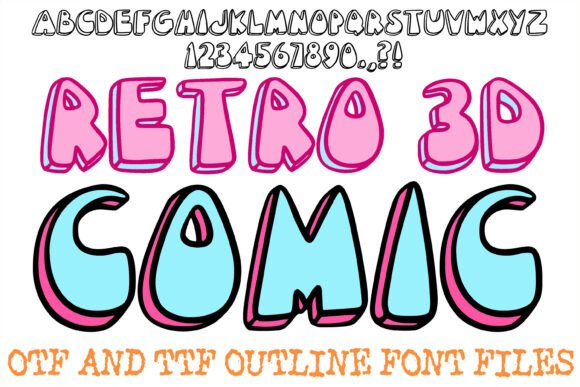
In the competitive landscape of visual branding and digital content, typography is rarely just about legibility; it is a primary vehicle for tone, era-specific nostalgia, and immediate audience signaling. The Retro 3D Comic font represents a specific strategic choice for designers and marketers aiming to evoke high energy, approachability, and vintage authenticity. Unlike neutral sans-serifs or traditional serifs that recede into the background to support copy, this typeface demands foreground attention. Its chunky, bubble-style characters and classic offset shadow create a tangible sense of depth that mimics the tactile experience of mid-century print media and 90s pop culture.
For entrepreneurs, creators, and marketing professionals, selecting Retro 3D Comic is a decision that should be grounded in communication goals rather than aesthetic preference alone. This typeface functions as a visual shorthand. It instantly communicates playfulness, action, and nostalgia without requiring explanatory text. When utilized intentionally, it can significantly reduce the cognitive load required for an audience to understand the vibe of a project, whether that is a superhero-themed event, a gaming channel identity, or a retro-inspired product launch. However, its bold nature requires a disciplined approach to hierarchy and spacing to ensure it enhances rather than overwhelms the user experience.
Defining the Strategic Value of Dimensional Display Type
To leverage Retro 3D Comic effectively, one must first understand what it signals to a modern audience. The font’s defining features—exaggerated 3D depth, hand-drawn silhouettes, and vibrant proportions—are not merely decorative. They are functional cues that trigger specific psychological associations. The "bubble" construction suggests safety and fun, making it ideal for family-oriented events or youth-focused brands. Simultaneously, the offset shadow and heavy weight anchor the design in a pre-digital aesthetic, suggesting authenticity and craftsmanship in an era of flat, minimalist corporate design.
From a positioning standpoint, this typeface serves as a differentiator. In sectors saturated with clean, tech-forward aesthetics, introducing a textured, dimensional element creates immediate contrast. For a small business owner or freelancer, this contrast can be the hook that stops a scroll on social media or draws the eye to a physical poster. The strategic value lies in its ability to convey personality at a glance. If your goal is to appear accessible, energetic, and creatively distinct, Retro 3D Comic aligns with those objectives more efficiently than generic display fonts.
Aligning Typography with Brand Voice and Audience Expectations
Before integrating this font into a brand system, decision-makers must audit their current voice against the font’s inherent tone. Retro 3D Comic is inherently informal and loud. It is strategically sound for:
- Entertainment and Gaming: Where immersion and excitement are primary KPIs.
- Nostalgia Marketing: Targeting Millennials and Gen X with 90s cultural touchstones.
- Youth Education and Activities: Creating welcoming, non-intimidating environments for children.
- Creative Portfolios: Signaling artistic range and an appreciation for design history.
Conversely, relying on this typeface for luxury goods, serious financial services, or somber memorial content would likely result in a tonal mismatch that erodes trust. The key to successful implementation is ensuring the font supports the message rather than contradicting it. When the visual style matches the verbal promise, conversion rates and engagement metrics tend to stabilize because the audience experiences a cohesive narrative.
Practical Applications and Operational Considerations
Moving from strategy to execution requires understanding the technical and operational realities of working with such a dominant typeface. Retro 3D Comic is a display font, meaning it is engineered for headlines, logos, and short bursts of text. Attempting to use it for body copy or lengthy informational sections is a common error that degrades readability and frustrates users. A practical rule of thumb is to limit its application to fewer than ten words per instance.
When designing assets like social media graphics or birthday invitations, consider the negative space. Because the characters have built-in 3D extrusion, they occupy more visual real estate than standard letters. Designers must adjust tracking (letter-spacing) and leading (line-height) to prevent the shadows from merging into illegible blobs. This is particularly critical when scaling designs across different platforms. A title that looks dynamic on a desktop monitor may become cluttered on a mobile screen if the 3D elements are not managed with precision.
Enhancing Customer Experience Through Visual Hierarchy
In customer-facing materials, clarity is paramount. Retro 3D Comic should serve as the entry point of your visual hierarchy, guiding the viewer’s eye to the most important information first. For example, on an event poster, the font might highlight the event name or date, while a clean, neutral sans-serif handles the venue details and ticketing information. This pairing ensures that the excitement generated by the display font is backed up by accessible utility.
For digital products and websites, performance is another consideration. Custom display fonts can impact load times if not optimized. Ensure you are serving web-safe formats (WOFF2) and limiting character sets to only what is necessary. A slow-loading site negates the engagement benefits of attractive typography. Furthermore, always pair this stylized font with highly legible body text. The contrast between the expressive header and the functional body copy creates a professional rhythm that keeps users engaged longer.
Risk Management and Intentional Design Decisions
While Retro 3D Comic offers significant creative advantages, unstrategic use carries risks. The most prevalent risk is visual fatigue. Because the font is high-energy, overusing it across multiple touchpoints can desensitize the audience. What feels exciting once becomes noisy when repeated excessively. Strategic restraint preserves the font’s impact. Use it for campaigns, seasonal promotions, or specific product lines rather than as a permanent fixture in every communication.
Another risk involves accessibility. The exaggerated shapes and integrated shadows can sometimes reduce contrast ratios or make letterforms difficult to distinguish for visually impaired users. Responsible design practice dictates testing color combinations rigorously. Avoid placing the 3D shadow directly against a busy background image; instead, use solid color blocks or gradients behind the text to maintain separation and legibility. Accessibility is not just a compliance issue; it expands your potential reach and demonstrates professional competence.
Avoiding Trend Dependency in Long-Term Planning
Nostalgia operates in cycles. While the current market responds positively to 90s and comic-book aesthetics, trends eventually saturate. Decision-makers should view Retro 3D Comic as a tactical tool within a broader brand system, not the foundation of the brand itself. Build your core identity on timeless principles and versatile assets, using this specific typeface to tap into current cultural moments or specific campaign goals. This modular approach allows you to pivot when trends shift without requiring a complete rebrand.
Additionally, consider licensing and scalability. If you are a freelancer or agency creating work for clients, ensure the font license covers commercial distribution, web embedding, and merchandise printing. Legal oversights regarding typography can lead to costly disputes down the line. Verifying usage rights is a fundamental step in professional operations that protects both the creator and the client.
Maximizing ROI Through Contextual Relevance
Ultimately, the return on investment for any design asset is measured by its effectiveness in achieving business outcomes. Retro 3D Comic delivers value when it solves a specific communication problem. Are you trying to make a gaming channel feel more authentic? Does a birthday invitation need to stand out in a crowded mailbox? Is a social media ad failing to capture attention in the first second? In these contexts, the font acts as a lever for engagement.
Track the performance of designs featuring this typeface against control designs. A/B test headlines on landing pages or compare engagement rates on social posts. Data-driven validation moves typography selection from subjective art to objective strategy. You may find that while the font increases click-through rates, it lowers time-on-page if used incorrectly, or vice versa. These insights refine future decision-making and help build a proprietary playbook for your specific audience.
By treating Retro 3D Comic as a strategic resource rather than a mere decoration, professionals can harness its vibrant energy to create memorable, effective, and commercially viable design work. The goal is always alignment: ensuring that every curve, shadow, and bubble serves the larger purpose of connecting with the audience and advancing organizational objectives. When executed with this level of intentionality, typography transcends aesthetics and becomes a driver of tangible results.