Redefining the Grid: How Demitro Transforms Typography into Architecture
In the vast landscape of digital typography, designers are often faced with a paradoxical choice: select a typeface that is safe and legible but ultimately forgettable, or choose something avant-garde that sacrifices readability for style. For decades, the grid system has served as the invisible scaffolding of design, providing order and rhythm to visual communication. However, traditional typefaces often fight against this structure, requiring constant manual adjustment to achieve perfect alignment. Enter Demitro, a precision-engineered display font that does not merely sit within the grid but actively redefines it.
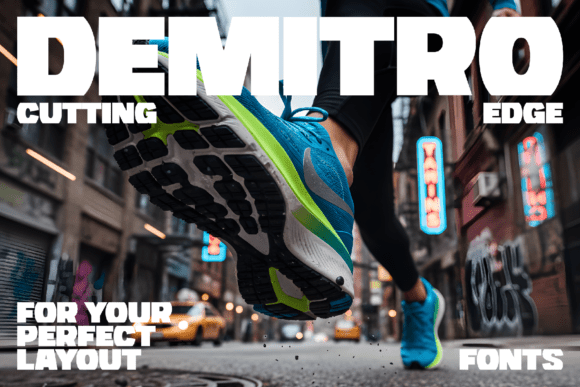
Demitro is not just another bold sans-serif added to an already saturated market. It represents a fundamental shift in how we approach display typography. By meticulously shearing the top and bottom of traditional letterforms, Demitro transforms standard characters into hyper-stable, squared-off blocks that command attention. The result is a typeface that feels less like writing and more like architecture, offering designers a new vocabulary for structure, balance, and impact.
The Concept: Where Form Meets Structural Function
To understand why Demitro matters, one must first understand the limitations of traditional sans-serif fonts. Classic heavy sans-serifs, while reliable, possess organic curves and varying ascenders and descenders that create uneven negative space. When set in tight layouts, these natural variations can make text blocks appear ragged or unbalanced, forcing designers to rely on optical corrections rather than mathematical precision.
Demitro’s DNA is rooted in the reliability of a classic heavy sans, yet its execution is purely modern. The defining characteristic of this typeface is its flat-cut philosophy. Every glyph has been engineered so that the vertical extremes are perfectly horizontal. This ensures that every line of text creates a perfectly aligned boundary without the need for manual kerning or leading adjustments. This unique geometric profile acts as a "cheat code" for achieving professional, balanced layouts with zero effort.
For general readers and budding designers, it is helpful to think of Demitro not as letters, but as modular building units. Just as bricks are shaped to stack seamlessly, Demitro’s characters are shaped to lock together. This distinction moves typography away from the fluidity of handwriting and toward the permanence of construction.
Why Alignment Matters in Modern Design
In our current digital ecosystem, where content is consumed rapidly across various screen sizes, visual stability equates to trust. A layout that feels shaky or misaligned can subconsciously signal a lack of professionalism. Demitro addresses this by baking alignment directly into the font file. This is particularly significant in responsive web design and mobile interfaces, where pixel-perfect control is often lost to varying viewport dimensions. By using a typeface that guarantees horizontal consistency, designers can maintain brand integrity regardless of the medium.
A Layout Essential: Practical Applications
The theoretical benefits of a squared-off typeface translate into tangible advantages in daily creative work. Whether you are designing a high-fashion editorial spread, a sports team identity, or a corporate annual report, Demitro offers specific utility that standard fonts cannot match.
Perfect Compositions and Tight Leading
One of the most immediate benefits of Demitro is its ability to handle tight leading (the space between lines of text). In traditional typography, reducing leading often risks characters colliding or creating awkward visual tension. Because Demitro features squared-off tops and bottoms, it creates natural snap-to points. Designers can stack lines of text directly on top of one another to create dense, poster-like textures that remain perfectly legible. This makes it ideal for:
- Event Posters: Maximizing information density without clutter.
- Social Media Graphics: Creating bold, thumb-stopping headlines in limited square formats.
- Packaging Design: Utilizing every millimeter of label space efficiently.
- Web Headers: Establishing strong horizontal rhythms that guide the eye across the screen.
Branding with an Edge
In the competitive world of branding, distinctiveness is currency. Many brands struggle to find a typeface that looks custom-designed without the budget for bespoke lettering. Demitro provides the impact of a custom logotype straight out of the box. Its silhouette is unmistakable, giving brands a sense of permanence and strength that softer, rounder fonts simply cannot convey.
This architectural quality suggests stability and engineering prowess, making it exceptionally well-suited for industries that value precision. Tech companies, architectural firms, automotive brands, and financial institutions can leverage Demitro to visually communicate their core values before a single word is read. Conversely, when used in fashion or lifestyle contexts, the font’s rigid structure provides a striking contrast to organic photography, creating a dynamic tension that feels contemporary and curated.
Maximum Versatility Without Sacrificing Legibility
A common misunderstanding about experimental display fonts is that they are inherently difficult to read. Designers often assume that a unique cut aesthetic implies compromised functionality. Demitro challenges this assumption. While its exterior boundaries are radically simplified, the internal counters and stroke widths retain the proportions of a highly legible basic bold font.
This duality allows Demitro to bridge the gap between art and utility. It is aggressive enough for heavy-duty sports branding yet refined enough for luxury editorial use. It proves that structure does not have to mean sterility; rather, structure can provide the foundation for clearer communication.
Integrating Demitro into Your Creative Workflow
Adopting a typeface like Demitro requires a slight shift in mindset. Because the font handles vertical alignment automatically, designers are freed from micro-managing spacing and can focus on macro-composition. Here are practical ways to integrate this tool into modern workflows:
- Establish a Modular Scale: Use Demitro’s inherent blockiness to define a strict grid system. Since the letters are essentially rectangles, they map 1:1 with grid columns and rows.
- Experiment with Negative Space: Treat the space around the text as active design elements. The sharp edges of Demitro create crisp boundaries that define negative space more effectively than curved typefaces.
- Pair with Organic Elements: To prevent layouts from feeling too mechanical, pair Demitro with fluid imagery, hand-drawn illustrations, or soft gradients. The contrast amplifies the strengths of both elements.
- Utilize Color Blocking: The solid, filled nature of Demitro’s forms makes it perfect for color blocking techniques. Text can serve as graphical shapes that anchor color fields in a composition.
The Broader Significance of Typographic Structure
Beyond its immediate utility, Demitro represents a broader trend in design education and practice: the return to foundational principles through modern technology. In an era of AI-generated imagery and fluid, chaotic layouts, there is a growing hunger for order, clarity, and intentionality. Demitro satisfies this hunger by reminding us that typography is, at its core, a system of organization.
For students and beginners, studying typefaces like Demitro offers a masterclass in form reduction. It demonstrates how stripping away non-essential elements can actually enhance function. For experienced professionals, it serves as a reminder that innovation often comes from revisiting basics—in this case, the rectangle—and refining them for contemporary needs.
Furthermore, this approach to typography aligns with accessibility standards. High-contrast, geometric sans-serifs with open counters are generally easier to read for individuals with dyslexia or visual impairments. By prioritizing clear silhouettes and consistent spacing, Demitro inadvertently supports inclusive design practices, proving that aesthetic rigor and social responsibility can coexist.
Conclusion: Building Better Visual Communication
Demitro is more than a collection of glyphs; it is a methodology for visual problem solving. By redefining the relationship between letterform and grid, it empowers designers to create work that is structurally sound, visually arresting, and effortlessly balanced. In a world overflowing with visual noise, the quiet confidence of architectural typography stands out.
Whether you are looking to elevate a brand identity, streamline your layout process, or simply explore the intersection of language and geometry, Demitro offers a compelling path forward. It invites us to stop thinking of text as mere content and start treating it as the structural foundation of our designs. In doing so, we do not just arrange letters; we build experiences that endure.