Donald: Where Celestial Whimsy Meets Typographic Precision
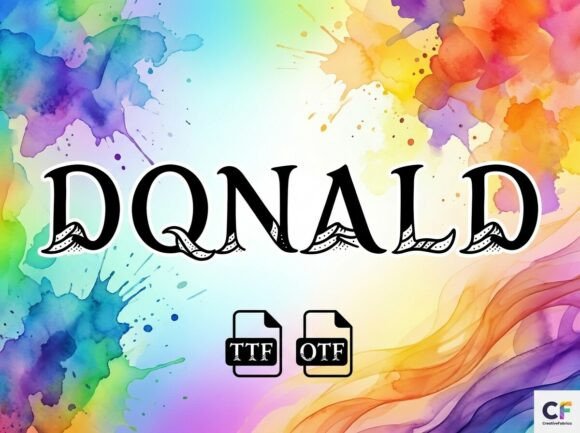
In the vast landscape of digital typography, designers often find themselves choosing between two extremes: the rigid authority of traditional serifs and the unstructured playfulness of hand-lettered scripts. Rarely does a typeface successfully bridge this divide without compromising legibility or aesthetic integrity. Donald emerges as a distinct solution to this dichotomy, offering a decorative display font that reimagines the serif structure through a lens of celestial whimsy. It is not merely a collection of glyphs but a narrative tool, transforming standard letterforms into anchored works of art featuring delicate, hand-drawn wings and rhythmic stippling.
For professionals ranging from boutique brand managers to children’s book illustrators, understanding the specific utility of Donald requires looking beyond its ornamental surface. This typeface represents a specialized intersection of fairytale soul and balanced typographic weight. Its value lies in its ability to convey enchantment while maintaining the structural discipline necessary for commercial and educational applications. By examining its anatomical construction, psychological impact, and practical implementation strategies, creators can leverage Donald to elevate projects that demand both imagination and professionalism.
Anatomical Balance in Ornamental Design
The primary challenge in designing a winged serif is preventing the ornamentation from overwhelming the message. In many fantasy fonts, the decorative elements compete with the counter spaces and stroke terminals, resulting in text that is difficult to parse at smaller sizes or in quick glances. Donald addresses this through high-contrast letterforms that serve as a sturdy architectural foundation. The stately nature of the base characters ensures that even when adorned with flowing patterns, the fundamental readability of the alphabet remains intact.
The integration of wings is executed with deliberate restraint. Rather than appearing as clip-art appended to existing letters, the wings function as organic extensions of the serifs themselves. This cohesion is achieved through rhythmic stippling—a technique involving precise dot work that creates texture and shadow without adding visual noise. The stippling provides a gradient effect that softens the transition between the solid stroke of the letter and the ethereal quality of the wing. For researchers and educators analyzing type design, this serves as a case study in how texture can be used to modulate visual weight in display typography.
The Role of Negative Space
A critical consideration when implementing Donald is the management of negative space. The extending wings naturally increase the horizontal footprint of each character. In typesetting, this requires adjusted tracking and leading to prevent the ornaments from tangling. However, this expanded spacing contributes to the font’s "breathing room," reinforcing the sense of airiness and magic. Unlike condensed display fonts that create urgency, Donald’s spatial requirements enforce a slower, more contemplative reading pace, which is essential for storytelling and immersive branding environments.
Strategic Applications in Narrative Branding
The semantic associations of typography are as important as their visual form. Donald carries an inherent vocabulary of nostalgia, safety, and wonder. These attributes make it uniquely suited for specific market sectors where trust and imagination must coexist. Business owners and marketers should view this typeface not just as a stylistic choice, but as a non-verbal communication signal that aligns with specific consumer psychographics.
- Children’s Fantasy Literature: The premier use case for Donald lies in book titles and chapter headers. The font signals to young readers and parents alike that the content within is safe yet adventurous. The hand-drawn quality suggests human craftsmanship, distinguishing physical books and premium e-books from mass-produced digital content.
- Boutique Enchanted-Themed Branding: For businesses in the wellness, artisanal craft, or metaphysical retail spaces, Donald communicates authenticity. It avoids the corporate sterility of geometric sans-serifs while steering clear of the illegibility often found in grunge or distressed fantasy fonts. It suggests a brand that is established yet magical.
- Artisanal Stationery and Invitations: In print media, the stippling and fine lines of Donald translate beautifully to textured papers. The high contrast allows for crisp reproduction via letterpress or foil stamping, making it ideal for wedding suites, birth announcements, and greeting cards where tactile experience matters.
- Social Media Storytelling: Content creators focusing on folklore, mythology, or creative writing can utilize Donald in headers and thumbnails to establish immediate genre recognition. The distinct silhouette of the winged serifs acts as a visual hook in crowded social feeds.
Technical Considerations for Digital and Print Implementation
While Donald possesses an ethereal soul, its successful deployment relies on technical proficiency. Designers must account for the intricate details of the stippling and wing structures across different mediums. What looks exquisite on a high-resolution monitor may degrade in low-quality print or small-scale web rendering. Understanding these limitations is key to maintaining the font's integrity.
Scaling and Resolution Dependencies
Because Donald relies on fine stippling and delicate line work, it is inherently resolution-dependent. In digital environments, it performs best at larger sizes where individual dots and curves remain distinct. Using this typeface for body copy or small UI elements is generally inadvisable; the ornamental details will blur, creating visual artifacts that hinder accessibility. For web designers, this means reserving Donald strictly for H1 and H2 tags or hero images, pairing it with a clean, highly legible serif or sans-serif for supporting text.
In print production, the stippling requires careful attention to ink spread and paper stock. On uncoated or highly absorbent papers, the fine dots may bleed together, turning the delicate shading into solid blobs. Designers working with artisanal stationery should request press proofs specifically to test how the wing details interact with the chosen substrate. Conversely, on glossy or coated stocks, the high contrast of the letterforms can appear sharp and vibrant, though care must be taken to avoid moiré patterns if the stippling interacts with halftone screens.
Pairing Strategies for Visual Hierarchy
Donald is a protagonist; it demands attention. To maintain a balanced layout, it must be paired with typefaces that act as supportive foils. A common error is pairing Donald with other decorative or script fonts, which creates visual chaos and dilutes the impact of the winged serifs. Instead, effective hierarchy is achieved through contrast.
- Geometric Sans-Serifs: Fonts like Montserrat or Futura provide a modern, neutral backdrop that allows Donald’s organic curves to stand out. The mathematical precision of a geometric sans contrasts pleasantly with the hand-drawn imperfections of the wings.
- Traditional Transitional Serifs: For a more classic, literary feel, pairing Donald with a typeface like Baskerville or Caslon reinforces the bookish aesthetic. The shared serif DNA creates harmony, while the lack of ornamentation in the body font ensures the text remains readable.
- Monospaced Typefaces: For contemporary editorial designs or indie publishing, a monospaced font can add a raw, typewriter-esque texture that grounds Donald’s flighty whimsy in tangible reality.
The Psychology of Hand-Drawn Typography in Modern Media
In an era dominated by AI-generated imagery and algorithmic design, the presence of hand-drawn elements like those found in Donald triggers a specific psychological response known as the "human touch" heuristic. Consumers and audiences subconsciously associate visible craftsmanship with care, authenticity, and emotional depth. When a viewer encounters the rhythmic stippling of Donald’s wings, they are processing evidence of human intention rather than computational generation.
This is particularly relevant for educators and child development professionals selecting materials for early literacy. Typography that feels approachable and organic can reduce the cognitive load associated with learning to read. While Donald is too ornate for primers, its use in environmental print, classroom decor, and storybook covers helps create a welcoming literacy ecosystem. The "fairytale soul" of the font validates the imaginative world of the child, signaling that the space they are entering is one where creativity is valued alongside structure.
Furthermore, for business owners in the experience economy, this human-centric typography serves as a differentiator. As markets become saturated with minimalist, tech-forward aesthetics, the return to ornamental, expressive type represents a counter-movement toward warmth and narrative. Donald allows brands to participate in this trend without resorting to cliché medieval or gothic tropes. It offers a refined, celestial alternative that feels timeless rather than dated.
Navigating Accessibility and Inclusivity
While Donald is a celebration of aesthetics, responsible design requires considering accessibility. Decorative display fonts can pose challenges for neurodivergent readers or those with visual impairments. The complex shapes and varying stroke widths may be harder to decode than standard letterforms. Therefore, inclusivity dictates that Donald should never be used for essential navigational information, long-form instructional text, or critical safety warnings.
However, accessibility also encompasses emotional and cultural inclusion. Providing diverse visual representations of magic and fantasy is important. Donald’s specific style of whimsy—celestial and airy rather than dark or aggressive—offers a gentler entry point into fantasy genres for audiences who may find traditional horror-adjacent fantasy typography alienating. By using Donald, creators can signal a tone of benevolent wonder, broadening the appeal of their content to sensitive readers or those seeking comforting narratives.
When using Donald in digital formats, always ensure that the underlying code supports screen readers correctly. Even if the visual presentation is highly stylized, the alt text or HTML structure must convey the semantic meaning clearly. The font enhances the experience for sighted users, but it should never obscure the information architecture for those relying on assistive technology. This balance of artistic expression and functional clarity is what separates professional typographic application from mere decoration.
Preserving the Ethereal in Variable Environments
Finally, maintaining the integrity of Donald across variable environments requires ongoing vigilance. Trends in web performance often prioritize speed over fidelity, leading to aggressive font subsetting or compression that can destroy delicate stippling. Developers and designers must advocate for adequate file sizes and proper rendering hints when deploying Donald online. The loss of fine detail transforms a celestial masterpiece into a muddy approximation, undermining the very reason for choosing such a specialized typeface.
Similarly, in video and motion graphics, the animation of Donald requires respect for its static beauty. Rapid movement or excessive distortion effects can negate the hand-drawn quality. Subtle parallax effects, gentle fades, or slow reveals honor the font’s stately nature. The goal is to extend the typographic personality into the temporal dimension without breaking the spell. Whether in print, on screen, or in motion, Donald succeeds when treated as a piece of illustrative art that happens to be readable, rather than merely text that happens to be pretty. This mindset shift is essential for unlocking the full potential of celestial whimsy in contemporary design practice.