Metal: Integrating Prehistoric Charm and Typographic Sophistication in Visual Design
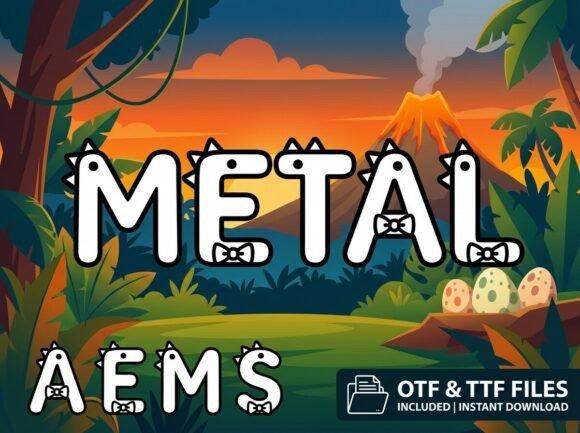
In the vast ecosystem of display typography, finding a typeface that balances whimsy with structural integrity is a persistent challenge for designers. While many novelty fonts sacrifice legibility for thematic accuracy, Metal emerges as a distinct solution that bridges the gap between playful illustration and functional lettering. This typeface captures a dino-mite-and-dapper soul, offering a unique visual vocabulary where bold, rounded letterforms are masterfully personified as rhythmic, hand-drawn dinosaurs. By integrating jagged back spines, curious eyes, and sophisticated bow ties directly into the glyph structure, Metal provides a rare combination of heavy graphic weight and narrative personality.
For professionals ranging from museum curators to independent toy manufacturers, understanding the specific utility of such a specialized display font is essential. It is not merely an aesthetic choice but a strategic communication tool designed to evoke specific emotional responses while maintaining brand recognition. The following analysis explores the practical applications, design mechanics, and implementation strategies for Metal across various creative industries.
Strategic Applications in Educational and Cultural Branding
The primary strength of Metal lies in its ability to soften academic or scientific subjects without diminishing their importance. In the context of independent children’s museums and educational centers, branding must navigate a delicate line: it must be approachable enough to engage young visitors yet credible enough to satisfy parents and educators. Standard comic-style fonts often skew too juvenile, while traditional serifs can appear intimidating or sterile.
Metal addresses this dichotomy through its "dapper" aesthetic. The inclusion of bow ties and refined curves within the dinosaur-inspired forms suggests a sense of gentlemanly scholarship. This makes it an premier choice for signage, exhibition titles, and wayfinding systems in natural history museums or science centers. When used in these environments, the font acts as a visual translator, converting complex paleontological concepts into accessible, friendly narratives. The heavy graphic weight ensures high visibility from a distance, a critical factor for physical signage, while the hand-drawn quality retains a human touch that digital perfection often lacks.
- Exhibition Headers: Utilizing Metal for main gallery titles creates an immediate thematic anchor that signals fun learning rather than rigid instruction.
- Wayfinding Signage: The bold, rounded letterforms offer excellent contrast against varied background colors commonly found in interactive museum spaces.
- Educational Materials: Worksheets and activity guides benefit from the font's personality, increasing engagement rates among early readers and visual learners.
Commercial Viability in Product Packaging and Retail
Beyond institutional use, Metal demonstrates significant commercial viability in the competitive landscape of children’s products and creative toy packaging. Shelf impact is determined by how quickly a consumer can process visual information and form an emotional connection. In the toy aisle, where visual noise is high, distinctiveness is currency. Metal’s rhythmic, hand-drawn dinosaurs create a texture that stands out against the smooth, vector-based sans-serifs that dominate mass-market packaging.
The typeface functions effectively as both text and image. Because the characters themselves are illustrative, designers can often reduce reliance on supplementary clip art or mascots. This allows for cleaner packaging layouts where the typography carries the thematic load. For boutique brands and independent creators, this efficiency is valuable. It enables a cohesive brand identity where the logo, product name, and descriptive text share the same DNA. Furthermore, the sophisticated undertones of the font allow products to appeal to adult purchasers who appreciate design-conscious aesthetics, distinguishing premium toys from generic alternatives.
Enhancing Digital Engagement Through Thematic Consistency
In the digital realm, attention spans are fleeting. Social media headers and digital banners serve as the first point of contact for many audiences. Metal is optimized for these high-impact environments, specifically for jurassic-and-jovial social media campaigns. The heavy weight of the letterforms translates exceptionally well to screen displays, ensuring readability even when scaled down for mobile viewing.
However, successful digital implementation requires more than simply applying the font. Designers must consider the interplay between the typeface’s inherent rhythm and the platform’s layout constraints. The integrated spines and tails of the Metal glyphs extend beyond standard cap heights and baselines. In social media headers, this organic irregularity breaks the grid, creating dynamic negative space that draws the eye. When paired with solid color blocks or subtle textures, the font becomes a focal point that encourages user interaction. For event promotions, such as dinosaur-themed birthday parties or seasonal museum events, this typographic voice sets clear expectations before the user even reads the content.
Anatomical Analysis: Balancing Illustration and Legibility
To utilize Metal effectively, one must understand its anatomical construction. Unlike standard novelty fonts where illustrations are merely superimposed over letters, Metal features personification that is structural. The jagged back spines follow the natural stress lines of the letterforms, and the bow ties are positioned at optical centers that aid in character recognition. This intentionality is what separates a professional display typeface from a hobbyist creation.
The rounded nature of the glyphs contributes to a psychological perception of safety and friendliness. Sharp angles in typography are often associated with danger or urgency, whereas curves suggest comfort and play. Metal leverages this psychological principle while retaining enough edge—literally, through the dinosaur spines—to prevent the design from becoming saccharine. The "curious eyes" integrated into specific characters add a layer of anthropomorphism that invites empathy. When setting text in Metal, designers should be mindful of tracking (letter spacing). Due to the complex silhouettes of the characters, tighter tracking may cause visual collisions between spines and adjacent letters. Generous spacing typically enhances the rhythmic flow and preserves the individuality of each dinosaur-letter hybrid.
Pairing Strategies and Hierarchy Management
A common pitfall when working with highly stylized display fonts is the failure to establish proper typographic hierarchy. Metal is a headline font; it demands attention and occupies significant visual real estate. Attempting to use it for body copy or extended paragraphs will result in fatigue and poor readability. The complexity that makes it charming at large sizes becomes noise at small sizes.
Effective pairing involves selecting supporting typefaces that provide stability and neutrality. A clean, geometric sans-serif or a humanist sans-serif often works best. These neutral partners ground the exuberance of Metal, allowing it to shine without overwhelming the layout. For example, in a birthday invitation, Metal might handle the "Happy Birthday" header and the child's name, while a simple sans-serif conveys the date, time, and RSVP details. This contrast not only improves legibility but also elevates the perceived value of the design. The juxtaposition of the prehistoric-and-dapper display face against modern, minimalist text reinforces the unique character of Metal by providing a quiet backdrop.
Technical Considerations for Print and Production
When moving from screen to print, particularly for packaging and physical signage, technical specifications become paramount. The hand-drawn aesthetic of Metal implies organic edges, but production methods vary in their ability to reproduce these details. For offset printing and high-quality digital presses, the font renders beautifully, capturing the subtle variations in stroke width that give it life. However, for vinyl cutting, embroidery, or low-resolution screen printing, the intricate details like the bow ties and facial features may require simplification or increased minimum size thresholds.
Designers preparing files for production should always outline the text to preserve the exact glyph shapes, preventing substitution issues if the receiving printer lacks the font license. Additionally, because Metal relies on heavy graphic weight, ink spread (dot gain) on uncoated papers can fill in the negative spaces within the characters. Testing on the actual substrate is recommended to ensure the "curious eyes" remain open and distinct. In large-format applications like museum banners, the file resolution must be sufficient to maintain crisp edges; pixelation in a hand-drawn font destroys the illusion of craftsmanship.
Licensing and Ethical Usage in Commercial Projects
As with any specialized typeface, understanding licensing is part of professional practice. Metal is a creative asset, and its usage rights dictate where and how it can be deployed. For business owners and agencies, verifying that the license covers intended uses—such as merchandise for sale, embedded web fonts, or broadcast media—is non-negotiable. Independent creators often favor Metal for its unique voice, but scaling a business requires ensuring compliance as distribution channels expand.
Furthermore, ethical usage involves respecting the integrity of the design. While customization is a hallmark of creative work, altering the fundamental proportions of Metal can disrupt the carefully calibrated balance between dinosaur and letterform. If modifications are necessary for a specific brand adaptation, they should be done with an understanding of the original designer’s intent. Maintaining the rhythmic consistency ensures that the typeface continues to communicate its intended message of jovial sophistication. Ultimately, Metal serves as a testament to the idea that functional design need not be boring, and that historical themes can be reimagined with contemporary relevance and dapper style.