Finlay Font: Adding Playful Volume and Soft Charm to Creative Design
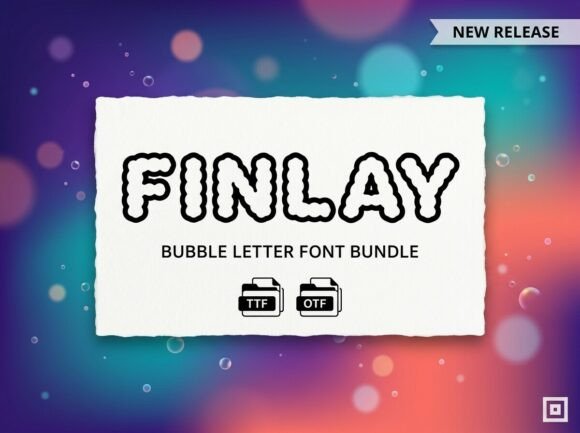
In the vast landscape of digital typography, finding a typeface that balances professional legibility with genuine emotional warmth can be a challenge. Designers often oscillate between sterile geometric sans-serifs and overly chaotic novelty fonts that sacrifice readability for quirkiness. Enter Finlay, a charming bubble letter font bundle specifically engineered to bridge this gap. Designed for lighthearted impact, Finlay injects a burst of playfulness into creative projects without compromising on aesthetic cohesion. This typeface features soft, pillowy letterforms defined by a unique, cloud-like scalloped outline, giving every character a sense of airy volume that feels both nostalgic and distinctly modern.
Whether you are crafting children’s party invitations, designing whimsical nursery decor, or developing vibrant social media graphics, understanding the utility of Finlay is essential for contemporary visual communication. This article explores the anatomy of this friendly, hand-drawn aesthetic, its practical applications across various industries, and why soft typography is becoming a crucial tool in the modern designer's arsenal.
The Anatomy of Softness: Understanding Finlay’s Design Language
To fully appreciate why Finlay works so effectively, one must understand its construction. Unlike traditional bubble letters that rely on perfect circles and uniform strokes, Finlay utilizes a scalloped outline technique. This design choice mimics the organic irregularity of clouds or rising dough, creating a tactile sensation even on a flat screen. The letterforms are not merely outlined; they possess an internal weight that suggests inflation, making the text appear three-dimensional and touchable.
This "pillowy" quality serves a specific psychological purpose in design. Rounded, soft shapes are universally associated with safety, comfort, and approachability. In contrast to sharp angles, which can signal danger or urgency, Finlay’s curves invite the viewer to linger. For designers, this means the font does heavy lifting in establishing tone before the viewer even processes the semantic meaning of the words. It is an exceptional choice for headlines where the goal is to disarm the audience and create an immediate emotional connection.
Versatility Across Creative Verticals
While Finlay is undeniably playful, categorizing it solely as a "kids' font" is a common misunderstanding that limits its potential. Its hand-drawn aesthetic has found relevance in several sophisticated design verticals:
- Children’s Education and Events: Naturally, this is Finlay’s home turf. For classroom materials, the font’s high x-height and open counters support early literacy while maintaining engagement. For party invitations, it signals fun and celebration instantly.
- Youth-Oriented Branding: Modern brands targeting Gen Z and Gen Alpha often reject corporate sterility in favor of authenticity. Finlay provides a sense of joyful energy that aligns with youth culture’s preference for expressive, imperfect visuals.
- Lifestyle and Wellness Blogs: In the wellness space, softness equates to self-care. Using Finlay for blog headers or quote cards can soften the delivery of advice, making content feel more like a conversation with a friend than a lecture.
- Social Media Content Creation: On platforms like Instagram and TikTok, users scroll rapidly. Finlay’s unique silhouette creates a pattern interrupt, stopping the scroll through its distinctive texture and volume.
Practical Application: Integrating Finlay into Modern Workflows
Understanding the theory behind Finlay is only half the battle; knowing how to implement it effectively is where true design mastery lies. Because Finlay is a display font with significant personality, it requires careful pairing and spacing to maintain professional standards.
Pairing Strategies for Balance
The most frequent mistake beginners make when using highly stylized fonts like Finlay is overuse. To maintain clarity and hierarchy, Finlay should almost always be paired with a neutral counterpart. A clean geometric sans-serif or a simple humanist typeface works best to ground the composition. For example, if you are designing a nursery poster, use Finlay for the baby’s name or the main greeting, but utilize a legible sans-serif for the date, time, and logistical details. This contrast ensures that the playfulness of Finlay shines without rendering the critical information unreadable.
Color and Texture Considerations
Finlay’s cloud-like outline interacts beautifully with color. Because the forms have inherent volume, they respond well to gradients and subtle shadows that enhance the 3D effect. However, designers should be cautious with high-contrast outlines. Since the scalloped edge already provides definition, adding a thick black stroke can sometimes clutter the form and reduce the "airy" feeling. Instead, consider using tonal variations or pastel palettes that complement the font’s inherent softness. For digital applications, ensure that the intricate scallops remain crisp at smaller sizes; testing across multiple devices is mandatory to preserve the hand-drawn integrity.
The Significance of Playful Typography in Digital Spaces
Why does a font like Finlay matter in a broader context? As our daily lives become increasingly mediated through screens, there is a growing fatigue associated with digital coldness. Users crave tactile charm in virtual environments. Typography is no longer just a vessel for information; it is a primary interface for emotional user experience (UX).
In educational technology, for instance, the shift toward softer, friendlier interfaces has been shown to reduce cognitive load and anxiety in young learners. Finlay fits into this pedagogical evolution by making digital content feel less institutional. Similarly, in e-commerce, particularly within the handmade, craft, or family sectors, typography acts as a proxy for human touch. When a customer reads a headline set in Finlay, they subconsciously attribute the qualities of the font—care, softness, joy—to the brand itself. This is the power of semantic typography: the shape of the letter communicates as loudly as the word itself.
Clarifying Common Misunderstandings
Despite its strengths, there are assumptions about bubble letter fonts that need addressing:
- "It’s unprofessional": Professionalism is contextual. If your brand voice is warm, accessible, and creative, using a rigid serif font would actually be unprofessional because it misrepresents your identity. Finlay is professional when used intentionally within its appropriate niche.
- "It’s hard to read": While Finlay should not be used for body copy, its letterforms are distinct and well-spaced. Legibility issues usually arise from poor color contrast or insufficient sizing, not the font design itself.
- "It’s only for kids": As discussed, the nostalgia and softness associated with bubble letters appeal to adults seeking comfort and levity. It is a cross-generational design element when styled correctly.
Building a Broader Understanding of Display Typography
Exploring Finlay offers a gateway to understanding the wider world of display typography. Display fonts are designed to be seen at large sizes and short durations. They are the vocal inflection of written language. Just as you would change your tone of voice when telling a joke versus reading a legal contract, you must change your typographic voice to match the content.
For aspiring designers and seasoned professionals alike, mastering fonts like Finlay involves developing an eye for negative space. The air inside and around the scalloped letters is just as important as the ink. When setting headlines, pay attention to the rhythm created by these internal spaces. Adjust tracking (letter-spacing) carefully; too tight, and the clouds merge into a blob; too loose, and the word loses its cohesive shape. This sensitivity to micro-typography is what separates amateur layouts from polished, impactful designs.
Conclusion: Embracing Joyful Energy in Design
Finlay represents more than just a collection of vector shapes; it is a tool for injecting humanity and joy into visual communication. Its unique, cloud-like scalloped outline and pillowy volume offer a refreshing alternative to the rigidity of standard web-safe fonts. By understanding its anatomical uniqueness, respecting pairing hierarchies, and recognizing its psychological impact, creatives can leverage Finlay to build stronger emotional connections with their audiences.
Whether you are designing for a youth-oriented brand, creating educational resources, or simply want to add a touch of whimsy to a lifestyle blog, Finlay delivers a sense of joyful energy that resonates. In a digital world that often feels flat and impersonal, embracing the soft, tactile charm of thoughtful typography is not just a stylistic choice—it is a strategic act of empathy. As you integrate Finlay into your next project, remember that you are not just arranging letters; you are shaping the emotional atmosphere of your design.