Why Gliches Is Redefining Visual Impact in Modern Digital Design
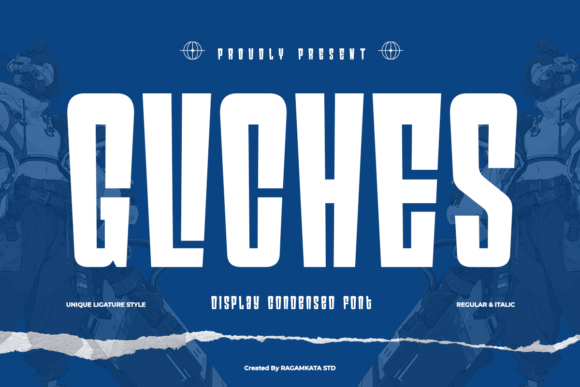
In the rapidly evolving landscape of digital communication, the margin for capturing audience attention has never been thinner. For professionals, creators, and marketers, typography is no longer merely a vessel for text; it is the primary interface between brand identity and consumer perception. Within this high-stakes environment, Gliches has emerged as a significant typographic tool, specifically engineered to meet the demands of contemporary visual culture. As a bold condensed display font built for high-impact visuals and strong typographic presence, Gliches represents a shift toward typefaces that function as graphic elements first and textual vehicles second.
The current design ecosystem is saturated with content. From social media feeds to esports broadcasts, audiences are bombarded with stimuli. In this context, traditional serif or standard sans-serif fonts often fail to arrest the scroll. Gliches addresses this saturation by drawing direct inspiration from modern gaming aesthetics and urban poster culture. It delivers a striking balance between compact structure and powerful readability, allowing designers to maximize spatial efficiency without sacrificing authority. This is not just a stylistic choice; it is a strategic response to the shrinking real estate of mobile screens and the expanding need for instant visual recognition.
The Intersection of Gaming Aesthetics and Commercial Branding
To understand why Gliches resonates with today’s market, one must look at the broader convergence of subcultures and mainstream commerce. The visual language of video games, once relegated to niche hobbyist circles, now dictates trends in fashion, music, and corporate marketing. The "gamer aesthetic" is characterized by high contrast, kinetic energy, and aggressive geometry. Gliches codifies this aesthetic into a usable commercial asset.
For entrepreneurs and brand managers targeting Gen Z and Millennial demographics, authenticity is paramount. Utilizing a typeface that feels native to digital-native environments signals cultural fluency. However, adopting raw gaming typography can sometimes result in illegibility or a lack of professionalism. Gliches bridges this gap. Its tall, narrow forms make it perfect for grabbing attention in tight spaces without losing visual dominance, ensuring that the edgy appeal does not compromise functional communication. This duality allows streetwear brands to maintain their underground credibility while remaining legible on e-commerce platforms, and enables tech companies to inject personality into otherwise sterile interfaces.
Spatial Efficiency in Responsive Design Workflows
Beyond aesthetics, the relevance of Gliches is deeply rooted in practical workflow adaptations. Modern designers operate across a fragmented media landscape where assets must scale from massive 4K monitors to smartwatch notifications. Condensed typefaces have historically been associated with utilitarian data tables or warning labels, but Gliches reclaims the condensed form as a premium design element.
The compact architecture of this typeface solves specific layout challenges inherent in responsive design:
- Vertical Dominance: On mobile-first platforms like TikTok or Instagram Reels, horizontal space is limited. The verticality of Gliches allows headlines to remain large and impactful without breaking awkwardly across lines.
- Information Density: For event posters, festival lineups, or data-heavy infographics, the narrow footprint allows for more content per square inch while maintaining a bold visual hierarchy.
- Cross-Platform Consistency: The font’s structural integrity holds up when scaled down for thumbnails or expanded for billboards, reducing the need for multiple typeface substitutions in a single campaign.
This efficiency aligns with changing expectations in design operations. Teams are expected to produce higher volumes of content at faster speeds. A versatile display font that reduces the friction of layout adjustments directly contributes to operational agility.
Ligatures as a Tool for Distinctive Identity Systems
In an era where AI-generated imagery and template-based design tools have lowered the barrier to entry, distinctiveness has become a scarce commodity. Generic typography is easily replicated; unique character interactions are not. One of the defining features of Gliches is its unique ligature style, which adds a distinctive twist to standard letter pairings.
For logo designers and branding specialists, these ligatures offer creative flexibility that goes beyond simple kerning adjustments. They provide built-in customization that helps craft proprietary wordmarks without requiring extensive custom lettering from scratch. This is particularly relevant for startups and freelancers who need to deliver bespoke identities within constrained budgets and timelines. The ligatures in Gliches create a sense of interconnectedness and flow, transforming static text into a cohesive graphical unit.
This feature also speaks to the growing demand for dynamic branding. Modern identity systems are rarely static; they must animate, adapt, and interact. The stylized connections in Gliches suggest movement and relationship, making them ideal for motion graphics and animated titles. When a logo locks together through intentional ligatures, it reinforces the idea of a unified brand system rather than a collection of disparate parts.
Meeting the Demands of Esports and Streetwear Markets
Two sectors where Gliches has found immediate traction are esports and streetwear. These industries share a reliance on hype cycles, limited drops, and intense community engagement. The typography used in these spaces must convey urgency and exclusivity.
In esports, visual clarity is non-negotiable. Tournament overlays, team jerseys, and stream graphics must be readable in milliseconds amidst chaotic gameplay. The bold weight and condensed width of Gliches ensure that player names and scores cut through visual noise. Simultaneously, the font’s stylistic roots resonate with the gaming community, avoiding the dissonance that occurs when corporate typography is forced onto gaming content.
Similarly, streetwear branding relies heavily on typographic expression. T-shirts, hoodies, and packaging often treat text as the primary illustration. Designers in this space require fonts that can carry the weight of a garment’s entire aesthetic. Gliches provides the necessary gravity. Whether used for a massive back print or a subtle neck label, it maintains a consistent tone of confident modernity. This versatility makes it a staple for agencies managing lifestyle brands that need to pivot between digital campaigns and physical merchandise seamlessly.
Future-Proofing Visual Communication
The adoption of specialized display fonts like Gliches reflects a maturation of the digital design industry. We are moving past the era of universal minimalism toward a period of expressive specificity. Professionals are recognizing that "clean" does not always mean "effective," and that personality is a measurable business asset.
As augmented reality (AR) and virtual reality (VR) interfaces become more prevalent, the need for typography that commands three-dimensional space will grow. Flat, delicate typefaces struggle in immersive environments. Bold, condensed forms with strong silhouettes are better suited to anchor user attention in spatial computing contexts. By integrating Gliches into current workflows, designers are effectively training their eyes and systems for the next generation of display technologies.
Furthermore, the psychological impact of typography cannot be overstated. In consumer psychology, bold condensed fonts are frequently associated with confidence, stability, and action. For marketers crafting calls-to-action or value propositions, the subconscious signal sent by the typeface supports the explicit message of the copy. Gliches leverages this association, providing a typographic voice that sounds as assured as the brands it represents.
Practical Implementation Strategies for Creatives
To maximize the utility of Gliches, professionals should consider it as part of a larger typographic ecosystem rather than a standalone solution. Because it is a display face with such strong character, it pairs best with neutral, highly legible body text. The contrast between the aggressive headline treatment and a clean geometric sans-serif for paragraphs creates a sophisticated tension that guides the reader’s eye effectively.
Designers should also explore the OpenType features embedded within the font. Accessing alternate characters and ligatures requires moving beyond default settings in software like Adobe Illustrator or Figma. Engaging with these features unlocks the full potential of the typeface and prevents designs from looking identical to others using the same family. Experimentation with color inversion—white text on dark backgrounds versus black on white—also reveals different facets of the font’s personality, given its origins in high-contrast screen environments.
Ultimately, the value of Gliches lies in its ability to solve modern problems with contemporary style. It acknowledges that today’s design challenges are as much about cultural resonance and spatial constraints as they are about legibility. For the forward-looking professional, it offers a reliable method to inject personality instantly, ensuring that visual communications do not just exist, but actively compete and connect in a crowded digital world. By understanding the context and capabilities of this typeface, creators can leverage it to build stronger, more resilient brand identities that stand the test of both trend cycles and technological shifts.