Saddle Up for Authenticity: Why Chaotic Cowboy Defines the Modern Western Aesthetic
In an era of digital saturation where sleek minimalism and algorithmic perfection often dominate visual culture, a counter-movement is gaining significant traction. Audiences and consumers are increasingly craving texture, history, and tangible imperfection. This shift has propelled Chaotic Cowboy from a niche typographic curiosity to a vital tool for brands seeking to establish genuine connections. Saddle up for a wild ride with this rugged display typeface, a design that captures a rebellious-and-frontier soul while addressing contemporary demands for authenticity in branding and digital media.
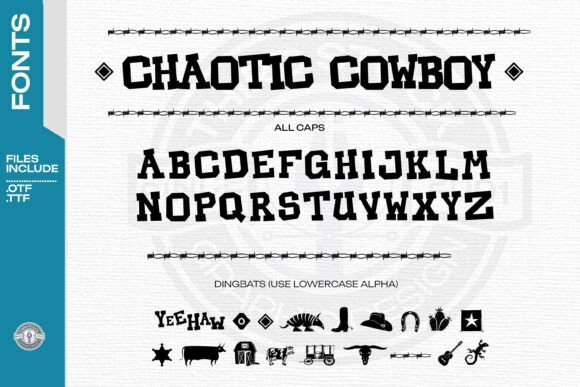
Chaotic Cowboy is not merely a font; it is a visual narrative device. Featuring heavy, all-caps slab serif letterforms with intentional chaotic irregularities, it mimics the tactile look of vintage woodblock prints from the Old West. However, its relevance extends far beyond historical reenactment. Accompanied by a comprehensive set of thematic dingbats—ranging from spurs and longhorns to barbed wire and armadillos—this typeface serves as a bridge between heritage aesthetics and modern marketing strategies. For professionals, creators, and entrepreneurs, understanding the utility of Chaotic Cowboy is essential for navigating the current landscape of experiential branding.
The Resurgence of Tactile Typography in Digital Spaces
To understand why Chaotic Cowboy is resonating so deeply with today’s market, one must look at the broader trajectory of graphic design and consumer psychology. For over a decade, the tech and lifestyle sectors were defined by flat design, sans-serif uniformity, and sterile whitespace. While functional, this aesthetic eventually led to a sense of visual fatigue. Consumers began to associate polished perfection with corporate detachment. In response, we are witnessing a robust return to "neo-analog" design principles.
This trend prioritizes typefaces that carry the weight of physical production. Chaotic Cowboy fits precisely into this gap. Its irregularities are not errors; they are features that signal human craftsmanship. When a user scrolls through a social media feed dominated by AI-generated smoothness, the rough edges of a slab serif display font act as a visual anchor. It stops the scroll not because it is loud, but because it feels real. For marketers and freelancers, leveraging this psychological trigger is a strategic advantage. It transforms a digital asset into something that evokes the sensory memory of ink on paper or iron on wood.
Beyond Stereotypes: Redefining Western Branding
Historically, Western typography was often relegated to caricature. Designs relied on clichéd tropes that felt more like costume parties than authentic cultural expressions. The modern market, however, demands nuance. Whether for an independent rodeo, a craft BBQ smokehouse, or a country music festival, audiences expect branding that respects the source material while feeling fresh and relevant.
Chaotic Cowboy succeeds because it balances nostalgia with contemporary legibility. It avoids the overly ornate script that plagues lesser western fonts, opting instead for bold, structural forms that read clearly at a distance and on small screens. This makes it uniquely suited for the omnichannel nature of modern business. A logo designed in Chaotic Cowboy works equally well on a weathered wooden sign outside a restaurant and as a profile header on Instagram. This versatility addresses a critical pain point for small business owners and creative directors who need cohesive identities across disparate platforms without sacrificing character.
The Strategic Value of Integrated Dingbats
One of the most practical aspects of Chaotic Cowboy is the inclusion of the Chaotic Cowboy Western Display Dingbats. In professional workflows, efficiency is paramount. Designers often waste hours sourcing, licensing, and vectorizing separate iconography to match a specific typeface. Having a dedicated set of thematic glyphs integrated into the font family streamlines the creative process significantly.
These dingbats serve multiple strategic functions:
- Visual Shorthand: Icons like spurs, longhorns, and barbed wire communicate complex themes instantly, reducing the cognitive load on the viewer.
- Brand Consistency: Using icons drawn with the same stroke weight and texture as the logotype ensures a unified visual language.
- Decorative Utility: Elements can be used to create borders, dividers, and background textures that reinforce the brand atmosphere without overwhelming the primary message.
- Social Media Optimization: In square or vertical formats, dingbats provide necessary negative space management and focal points that pure text cannot achieve alone.
For the entrepreneur managing their own brand assets, this integration lowers the barrier to entry for high-quality design. It allows non-designers to compose balanced layouts that feel professionally art-directed, simply by utilizing the tools already present in the font file.
Meeting the Needs of the Experience Economy
We are currently operating within an experience economy where products are secondary to feelings and stories. This is particularly true in the sectors where Chaotic Cowboy thrives. A BBQ smokehouse is not just selling meat; it is selling tradition, patience, and community. A country music festival is not just selling tickets; it is selling belonging and release.
Typography is the first touchpoint of this experience. When a potential customer encounters a poster or a website header, the typeface sets the emotional temperature before a single word is processed. The heavy, grounded nature of Chaotic Cowboy communicates stability and confidence. The chaotic elements suggest energy and unpredictability. This duality mirrors the actual experiences these businesses offer. By aligning visual identity with emotional reality, brands can increase conversion rates and foster deeper loyalty. It is a practical application of semiotics in business strategy.
Workflow Integration and Future-Proofing
As creative workflows evolve, so do the expectations placed on typographic tools. Professionals are no longer designing solely for print or solely for web; they are designing for systems. Chaotic Cowboy supports this systemic approach through its robust character set and scalable vector nature.
Furthermore, the rise of variable content creation means that assets must be adaptable. A social media manager might need a bold headline for a TikTok cover and a textured subhead for a newsletter. The all-caps construction of Chaotic Cowboy provides a consistent vertical rhythm that simplifies layout grids. Unlike mixed-case fonts where ascenders and descenders can complicate tight spacing, the uniform height of this display face allows for modular design systems that are easy to template and automate.
This forward-looking utility ensures that investing in this typeface is not a fleeting trend chase. As augmented reality and immersive digital environments become more prevalent, the demand for typefaces with distinct silhouettes and strong personalities will only grow. Flat, generic fonts disappear in 3D space; textured, heavy serifs retain their presence. Chaotic Cowboy is positioned to remain relevant as the canvas of communication expands beyond the two-dimensional screen.
Practical Applications for Modern Creators
Understanding the theory behind the font is valuable, but seeing its application clarifies its worth. Consider the following scenarios where Chaotic Cowboy provides a distinct competitive edge:
- Independent Rodeo Branding: Moving away from generic athletic aesthetics to highlight the grit and heritage of the sport. The font’s roughness validates the authenticity of the event.
- Craft Beverage Labeling: Whiskey distilleries and craft breweries use the typeface to signal artisanal production methods. The woodblock aesthetic suggests aging and barrel-char, enhancing perceived product value.
- Outdoor and Adventure Apparel: Brands targeting the "modern outlaw" demographic use the font to differentiate from mainstream outdoor gear. It appeals to consumers who view outdoor life as a cultural identity rather than just a hobby.
- Editorial and Publishing: Magazines and blogs covering Americana, folk music, or rural lifestyles utilize the dingbats as pull-quote markers and section headers to maintain thematic immersion throughout long-form content.
In each instance, the choice of typeface acts as a filter, attracting the right audience and repelling the wrong one. This specificity is the hallmark of effective modern marketing.
Cultivating a Distinct Visual Voice
Ultimately, the decision to use Chaotic Cowboy is a decision to embrace a specific point of view. In a marketplace crowded with safe choices, distinctiveness is a currency. Professionals and creators who adopt this typeface are signaling that they understand the value of heritage without being trapped by it. They are acknowledging that in a high-tech world, the human desire for the handmade, the rugged, and the storied remains undiminished.
By integrating the heavy slab serifs and thematic dingbats of Chaotic Cowboy into their visual arsenals, designers and business owners are doing more than decorating; they are communicating. They are telling a story of resilience, independence, and authentic character. As we move forward, the brands that succeed will be those that can articulate these values visually with clarity and conviction. Chaotic Cowboy offers the vocabulary to do exactly that, making it an indispensable asset for anyone looking to make a lasting impression in the modern frontier of design.