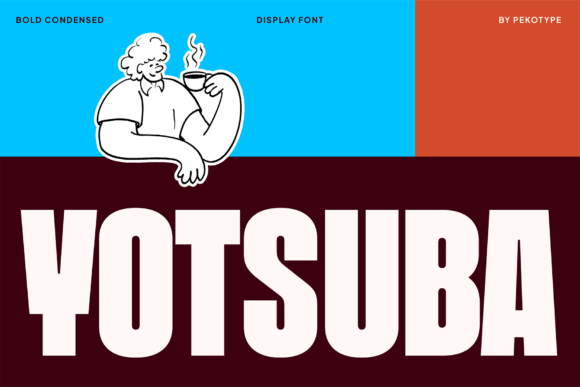
Yotsuba: A Bold Condensed Font for High-Impact Design
When you are designing a poster, a product label, or a social media graphic, space is often your most limited resource. You need text that screams for attention but doesn't force you to shrink the font size or cut important copy. This is exactly where Yotsuba solves a common layout problem. As a bold condensed display font with chunky shapes and smooth rounded details, it offers a unique combination of visual weight and spatial efficiency. The letters are thick, tight, and strong, providing a powerful modern aesthetic that remains surprisingly friendly and approachable.
Unlike sharp, aggressive condensed typefaces that can feel hostile or overly industrial, Yotsuba retains a sense of playfulness through its rounded terminals. This duality makes it exceptionally versatile for creators who need to balance authority with accessibility. Whether you are an entrepreneur launching a new beverage line, a marketer creating billboard ads, or a content creator designing YouTube thumbnails, understanding how to leverage this specific typographic style can significantly improve your visual communication.
Maximizing Visual Hierarchy in Tight Spaces
The primary functional benefit of Yotsuba is its condensed structure. In practical design scenarios, this means you can fit more characters per line without sacrificing legibility or impact. Consider the challenge of designing a mobile app banner or an Instagram story. Horizontal space is scarce, yet the headline still needs to be readable at a glance. Using a standard bold font might require breaking a three-word phrase into two lines, disrupting the visual flow. Yotsuba allows that same phrase to sit comfortably on a single line, maintaining a clean composition.
This spatial efficiency is equally valuable in print media. For street-style designs or event flyers, you often have a fixed canvas size packed with information like dates, venues, and sponsor logos. Yotsuba acts as a heavy anchor for the main title while leaving ample negative space for secondary details. Its tight kerning and sturdy vertical stress ensure that even when scaled down slightly for subheads, the text retains its structural integrity and doesn't become muddy or difficult to parse.
Commercial Applications: Packaging and Retail Signage
Product packaging is perhaps the most demanding environment for display typography. Shelf appeal relies on instant recognition, and Yotsuba excels here due to its high x-height and robust forms. For beverage labels, energy drinks, or snack packaging, the font’s chunky geometry conveys flavor intensity and brand confidence. The rounded details prevent the packaging from looking too severe, which is crucial for lifestyle brands targeting younger demographics or families.
Retail signage and billboards also benefit from this typeface's optical properties. When viewed from a distance or at high speeds, thin strokes disappear and complex serifs blur. Yotsuba’s uniform thickness ensures consistent visibility. A coffee shop using this font on their window decal or menu board communicates a modern, artisanal vibe without the pretension of minimalist sans-serifs. It feels established yet current, helping small businesses project professionalism alongside creativity.
Digital Content and Social Media Graphics
In the digital realm, attention spans are measured in milliseconds. Content creators and social media managers use Yotsuba to create "scroll-stopping" visuals. Because the font is all-caps and heavily weighted, it performs exceptionally well as overlay text on video content or carousel covers. The multilingual support is a critical feature here; global brands or educators creating content for diverse audiences can maintain typographic consistency across languages without switching fonts mid-design.
For bloggers and newsletter designers, Yotsuba serves as an excellent tool for breaking up long-form text. Using it for pull quotes, section headers, or call-to-action buttons creates a distinct rhythm that guides the reader through the content. Unlike generic bold fonts that blend into the background, Yotsuba’s distinctive character shapes add personality to digital layouts, reinforcing brand identity across different platforms.
Balancing Boldness with Approachability
One of the most common pitfalls with bold condensed fonts is that they can inadvertently signal aggression or urgency, which isn't always appropriate. Yotsuba mitigates this through its smooth, rounded details. This subtle softening makes it suitable for contexts where you want strength without intimidation. Educators creating classroom materials, non-profits designing fundraising campaigns, or healthcare providers making informational posters can use this font to convey importance while remaining welcoming.
This emotional versatility extends to personal projects as well. Hobbyists designing zines, stickers, or party invitations can achieve a professional, trendy look that feels handmade rather than corporate. The font’s inherent friendliness invites engagement, making it a safer choice for community-facing communications than sharper, more geometric alternatives.
Practical Considerations Before Implementation
Before integrating Yotsuba into your workflow, there are several practical factors to evaluate. First, remember that this is strictly a display font. It is engineered for headlines, titles, and short bursts of text. Attempting to use it for body copy or extended reading passages will result in fatigue and poor readability due to the tight spacing and heavy weight. Pair it with a clean, neutral sans-serif or serif for body text to create effective contrast.
Second, consider the technical specifications. Yotsuba comes in OTF and TTF formats, ensuring compatibility with major design software like Adobe Creative Cloud, Affinity, Canva, and Figma. The inclusion of numbers, symbols, and punctuation means you won’t encounter missing glyph issues when designing pricing tables, technical specs, or contact information. However, always test the font in your specific output medium. What looks perfect on a high-resolution monitor may need tracking adjustments when printed on textured paper or embroidered on merchandise.
Finally, think about brand alignment. While Yotsuba is versatile, its bold, condensed nature carries a specific voice. It speaks to modernity, energy, and directness. If your project requires elegance, tradition, or delicate refinement, this may not be the right tool. But if your goal is to make a statement that is both impactful and accessible, Yotsuba provides a reliable foundation. Its ability to command attention while maintaining a human touch makes it a valuable asset in any designer’s toolkit, bridging the gap between commercial effectiveness and creative expression.
- Ideal Use Cases: Posters, product packaging, branding, logos, social media graphics, billboards, app interfaces, and promotional visuals.
- Key Features: All caps design, comprehensive numbers and symbols, full punctuation set, and multilingual support.
- File Formats: Available in both OTF and TTF for maximum software compatibility.
- Design Tip: Reserve for headlines and display text only; pair with lighter weights for body copy to ensure readability.