Pansy: A Practical Review of a Balloon-Inspired Display Typeface
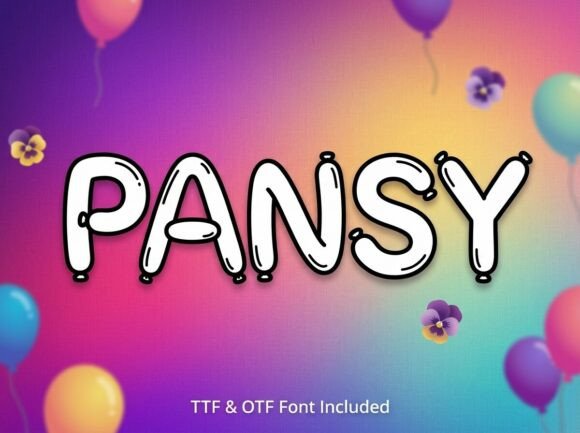
Selecting the right display typeface for celebratory design work often involves navigating a spectrum between generic novelty fonts and overly complex hand-lettering that fails to function as a cohesive system. Pansy occupies a distinct middle ground in this landscape. It is a buoyant display typeface that captures a festive, air-filled aesthetic through bold, rounded letterforms rendered as rhythmic, hand-drawn twisted balloons. Unlike standard bubble fonts or rigid geometric sans-serifs, Pansy offers a specific tactile quality characterized by subtle highlights and tiny knotted terminals at the base of each character. For designers, marketers, and event professionals seeking a typography solution that communicates joy without sacrificing graphic weight, understanding the functional nuances of this typeface is essential for effective project execution.
Visual Mechanics and Typographic Construction
The primary value proposition of Pansy lies in its successful translation of a three-dimensional physical object into a two-dimensional typographic form. The letterforms are not merely inflated; they are constructed to mimic the tension and torsion of actual balloon twisting. This distinction matters significantly in professional design because it prevents the font from appearing flat or digitally generated. The "twisted" aspect introduces a rhythmic cadence across the baseline, creating a sense of movement that static rounded fonts often lack.
Several construction details contribute to its usability in high-impact layouts:
- Knotted Terminals: The small knots at the base of characters serve a dual purpose. Visually, they reinforce the balloon metaphor, adding authenticity to the illustration. Functionally, they provide a consistent vertical anchor point, helping to stabilize the otherwise bouncy forms when set in headlines.
- Internal Highlights: Subtle shading and highlight vectors are integrated directly into the glyph outlines. This eliminates the need for post-production styling or external drop shadows to create depth, streamlining the workflow for social media graphics and print invitations.
- Heavy Graphic Weight: Despite the playful subject matter, the stroke width is substantial. This ensures legibility at smaller display sizes and maintains presence against busy photographic backgrounds or textured patterns common in party branding.
- Rhythmic Consistency: While the style is hand-drawn, the spacing and proportion are regulated enough to allow for tight tracking in short headlines without characters colliding awkwardly.
These mechanical choices position Pansy as a tool designed for specific visual outcomes rather than general-purpose text setting. It prioritizes atmosphere and immediate recognition over neutrality.
Practical Applications in Event Branding and Digital Media
Evaluating Pansy requires looking beyond its aesthetic appeal to assess its performance in real-world scenarios. Its strengths are most apparent in contexts where the emotional tone must be established instantly. Independent party planners and children’s birthday invitation designers will find the typeface particularly effective because it bridges the gap between juvenile playfulness and curated design. It avoids the chaotic energy of many "kids' fonts," offering instead a polished look that appeals to parents purchasing services while still signaling fun to the child audience.
In the realm of social media, Pansy performs well as a header or overlay font. Platforms like Instagram and TikTok prioritize content that arrests attention within milliseconds. The heavy weight and unique silhouette of the balloon letterforms create high contrast against video feeds or image carousels. Because the font includes built-in dimensionality, it remains readable even when placed over complex imagery without requiring extensive background masking or solid color blocks behind the text.
Carnival-themed event graphics represent another strong use case. These projects often require typography that feels organic and handmade to match the tactile nature of fairgrounds and festivals. Pansy’s hand-drawn origin aligns with this vernacular, providing a digital asset that retains analog warmth. For small business owners creating seasonal promotions or limited-time event signage, this typeface offers a way to achieve a custom-illustrated look without the budget or timeline required for bespoke lettering.
Workflow Integration and Technical Considerations
From a production standpoint, Pansy integrates smoothly into standard design workflows. As a vector-based display font, it scales indefinitely for large-format printing such as banners, backdrops, and window decals without pixelation. The inclusion of pre-rendered highlights means designers can change the color of the font to match brand palettes without losing the 3D effect, provided the highlight color contrasts sufficiently with the new base color.
However, users should approach pairing with intention. Due to its intense personality, Pansy demands a supportive but subordinate typographic partner. Clean, neutral sans-serifs or simple humanist serifs work best for body copy and logistical details. Avoid pairing it with other decorative or script fonts, as the visual competition will degrade readability and clutter the hierarchy. In terms of licensing and file formats, ensuring you have access to OpenType features (if available) can further enhance the hand-drawn feel through alternate characters or ligatures, though the base set is robust enough for most standalone headline applications.
Evaluating Limitations and Best Use Cases
While Pansy excels in its niche, objective evaluation requires acknowledging its limitations. It is strictly a display typeface. Attempting to use it for subheads, captions, or body text will result in poor legibility and visual fatigue. The intricate details of the knots and highlights become noise at small sizes, and the wide stance of the characters consumes excessive horizontal space in paragraph settings.
Furthermore, the tone is unapologetically jubilant. This makes it unsuitable for corporate communications, luxury weddings, somber announcements, or brands aiming for minimalist sophistication. Even within the party planning sector, it may clash with aesthetics that lean toward modern chic, boho neutral, or vintage elegance. Designers must assess whether the "festive-and-full-of-air" soul of the font aligns with the specific emotional target of the brief. If the goal is understated refinement, Pansy is likely the wrong tool.
There is also a consideration regarding longevity. Highly stylized novelty typefaces can sometimes feel dated as trends shift. However, Pansy’s reliance on the universal symbol of the balloon—rather than a specific era’s graphic trend—provides some insulation against rapid obsolescence. Balloons are a perennial symbol of celebration, suggesting that the typeface will retain its relevance for recurring annual events and evergreen party content longer than fonts tied to fleeting internet aesthetics.
Strategic Recommendations for Creatives
For freelancers and agencies building asset libraries, Pansy represents a high-value addition specifically for the celebration vertical. When evaluating whether to acquire or deploy this typeface, consider the following practical checklist:
- Audience Alignment: Does the client’s demographic respond to overt expressions of joy? Pansy works best for family-oriented, youth-focused, or community-centric events.
- Hierarchy Needs: Do you need a singular, dominant focal point? This font is a headline specialist, not a supporting actor.
- Background Complexity: Will the text sit on busy textures? The built-in weight and shading reduce the need for additional design elements to ensure contrast.
- Brand Voice: Is the brand voice energetic, welcoming, and uninhibited? The typeface carries an inherent extroversion that should match the verbal identity.
Ultimately, Pansy serves as a specialized instrument in the typographic toolkit. It solves a specific problem: how to convey the physics of celebration and the warmth of hand-crafted festivity in a scalable, editable digital format. By understanding its construction, respecting its limitations, and deploying it in appropriate contexts, designers can elevate celebration designs with confidence. It transforms standard event collateral into something that feels tangible and alive, proving that functional typography and expressive illustration can coexist effectively in professional design practice.