Sumi Ink Brush: Evaluating Authenticity and Versatility in Display Typography
Selecting the right typeface for a project that requires an organic, handcrafted aesthetic involves more than simply browsing a "handwritten" category. Designers and art directors must distinguish between fonts that merely simulate handwriting and those that genuinely replicate the physics of traditional media. Sumi Ink Brush occupies a specific niche within display typography by mimicking the authentic behavior of traditional ink brush calligraphy rather than relying on digital approximation. For professionals evaluating resources for Asian-inspired artwork, martial arts branding, streetwear, or moody editorial design, understanding the technical and aesthetic distinctions of this font is essential for making an informed selection.
Defining the Aesthetic: Beyond Standard Handwritten Fonts
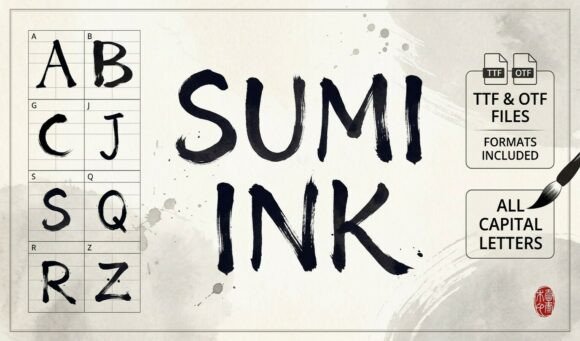
The primary differentiator of Sumi Ink Brush lies in its adherence to the physical properties of sumi-e (ink wash painting) and shodo (calligraphy). Many display fonts categorized as "brush" or "marker" are created using vector nodes that create smooth, uniform curves. While clean, these often lack the chaotic energy of real ink interacting with paper. Sumi Ink Brush is distinct because it prioritizes three specific visual characteristics that define traditional brushwork:
- Varying Line Weight: Unlike pressure-sensitive digital brushes that can sometimes look artificial, this typeface features stroke modulation that reflects the speed and angle of a physical brush. Thick downstrokes transition naturally into thin upstrokes without jagged edges or unnatural tapering.
- Dry Brush Textures: A hallmark of authentic calligraphy is the "flying white" effect, where the brush moves quickly enough that ink does not fully saturate the paper fibers. This font incorporates these textured breaks within the glyphs themselves, preventing the solid, plastic appearance common in lower-quality script fonts.
- Organic Imperfections: The inclusion of subtle ink splatters and edge bleed simulates the absorption rate of rice paper or washi. These details prevent the letterforms from looking too sterile when scaled up for posters or album covers.
When comparing options, it is vital to determine if your project requires this level of textural fidelity. If the goal is legibility at small sizes or a polished corporate identity, the inherent roughness of Sumi Ink Brush may be counterproductive. However, for projects demanding emotional resonance and tactile authenticity, these features provide a depth that smoother alternatives cannot achieve.
Evaluating Fit: Ideal Use Cases and Applications
Versatility in display typography does not mean universal applicability. Sumi Ink Brush excels in specific contexts where boldness and atmosphere take precedence over extended readability. Understanding where this typeface performs best helps avoid misapplication in layouts that require neutrality.
Cultural and Martial Arts Branding
For projects rooted in Asian aesthetics, accuracy matters. Generic "chop suey" fonts or stereotypical oriental typefaces often rely on caricatured serifs that feel dated and culturally insensitive. Sumi Ink Brush offers a respectful alternative by focusing on the actual mechanics of brush writing rather than decorative clichés. This makes it suitable for dojo signage, tea ceremony packaging, cultural festival materials, and martial arts merchandise where authenticity establishes credibility with the target audience.
Streetwear and Edgy Editorial Design
Modern streetwear and music album covers often utilize high-contrast typography to create visual tension. The dynamic sweeping strokes of Sumi Ink Brush pair effectively with minimalist sans-serifs or brutalist grid layouts. In these contexts, the font acts as a graphical element rather than just a vehicle for text. The varying line weights allow designers to lock up type tightly while maintaining negative space within the characters, creating a dense, energetic texture that reads well on apparel and large-format prints.
Horror and Moody Graphics
The unpredictability of ink splatters and dry brush edges lends itself naturally to horror themes, thriller book covers, and dark atmospheric branding. Unlike distressed grunge fonts that apply a uniform noise filter over standard letters, the irregularities in Sumi Ink Brush are structural. This creates a sense of unease or rawness that feels intentional rather than processed. When evaluating horror typography, this distinction ensures the design feels artisanal rather than like a stock asset.
Tradeoffs and Limitations: When to Choose Alternatives
No single typeface solves every design problem. While Sumi Ink Brush offers superior texture and expressiveness, it carries inherent tradeoffs that must be weighed against project requirements. Recognizing these limitations is as important as appreciating its strengths.
Legibility vs. Expression
The very features that make this font expressive—splatters, variable weight, and texture—reduce its legibility at smaller sizes. It is strictly a display face. For body copy, captions, or UI elements, you will need to pair it with a highly readable companion font. If your project requires a single typeface solution for both headlines and body text, Sumi Ink Brush is not the correct choice. You would be better served by a versatile serif or humanist sans-serif family that includes italic styles for accentuation.
Repetition in Extended Text
As with most hand-drawn display fonts, character repetition can become noticeable in longer headlines or multi-line arrangements. While OpenType alternates can mitigate this, there is a limit to how many unique variations exist within the font file. For short, punchy statements (three to five words), the variety is sufficient. For longer poetic verses or extensive titles, you may need to manually adjust spacing, swap characters, or combine multiple instances to maintain the illusion of unique hand-lettering. If your workflow prohibits manual tweaking, a font with extensive contextual alternates or a modular brush system might offer more automation.
Tone Compatibility
The bold, aggressive energy of Sumi Ink Brush dominates a layout. It is difficult to use passively. If your design requires a whisper-quiet background element or a sophisticated, understated luxury feel, this typeface may be too loud. In such cases, consider monoline scripts or refined serif italics that suggest handcraftsmanship without the visual volume of heavy ink saturation.
Comparative Decision Factors
When finalizing your typography selection, use the following criteria to determine if Sumi Ink Brush aligns with your current needs compared to other market options.
- Texture Source: Does the font derive its texture from actual ink scans or digital distress filters? Sumi Ink Brush uses the former, which scales better for large print. Digital filters often pixelate or reveal repeating patterns at high resolutions.
- Stroke Logic: Do the thick and thin transitions follow the logic of a brush held at an angle, or do they appear random? Authentic calligraphy follows specific ductus (stroke order and direction). Fonts that ignore this logic look wrong to viewers familiar with the tradition, even if they cannot articulate why.
- Licensing Flexibility: Display fonts are often used commercially for merchandise and branding. Verify that the license covers your intended end products. Some brush fonts are restricted to personal use or static images only, whereas professional projects involving apparel or packaging require broader commercial rights.
- Pairing Potential: Test the font alongside your intended secondary typeface before committing. The organic irregularity of Sumi Ink Brush generally pairs best with structured, geometric, or neutral grotesques. Pairing it with another decorative font usually results in visual conflict.
Making the Final Selection
Sumi Ink Brush represents a specialized tool for designers seeking to bridge the gap between traditional craft and modern digital application. Its value proposition centers on authenticity: it provides the visceral impact of wet ink without the time investment of custom lettering. For adult professionals managing tight deadlines who still demand artistic integrity, it serves as a reliable middle ground between generic stock assets and bespoke illustration.
However, effective design resource management requires matching the tool to the specific output. If your project demands high-energy, culturally resonant, or texturally rich display typography, this font is a strong contender. If your priorities are maximum legibility, subtle elegance, or automated consistency across long texts, exploring cleaner script families or modular brush systems may yield better results. By objectively assessing these factors against your project brief, you ensure that your typographic choice supports the communication goal rather than merely filling space with decoration.